
IRS Form 8949 for Crypto: How 1099-DA Reporting Will Be Matched in 2026
By Clinton Donnelly, CEO, Founder | CryptoTaxAudit
The IRS just separated crypto from everything else on Form 8949.
For the first time, they can isolate your digital asset transactions from stocks. They can match them directly against the 1099-DA reports brokers send them.
And they're building the infrastructure to catch discrepancies before you even file.
This isn't a minor form update. This is the IRS creating a dedicated tracking system for crypto gains.
Here's what changed, what it means for your 2025 tax return, and how to report correctly when cost basis numbers don't match.
What Changed on Form 8949 for Crypto in 2026?
Form 8949 is where you report every crypto sale, exchange, and taxable transfer. It's a spreadsheet-style form that separates short-term gains from long-term gains.
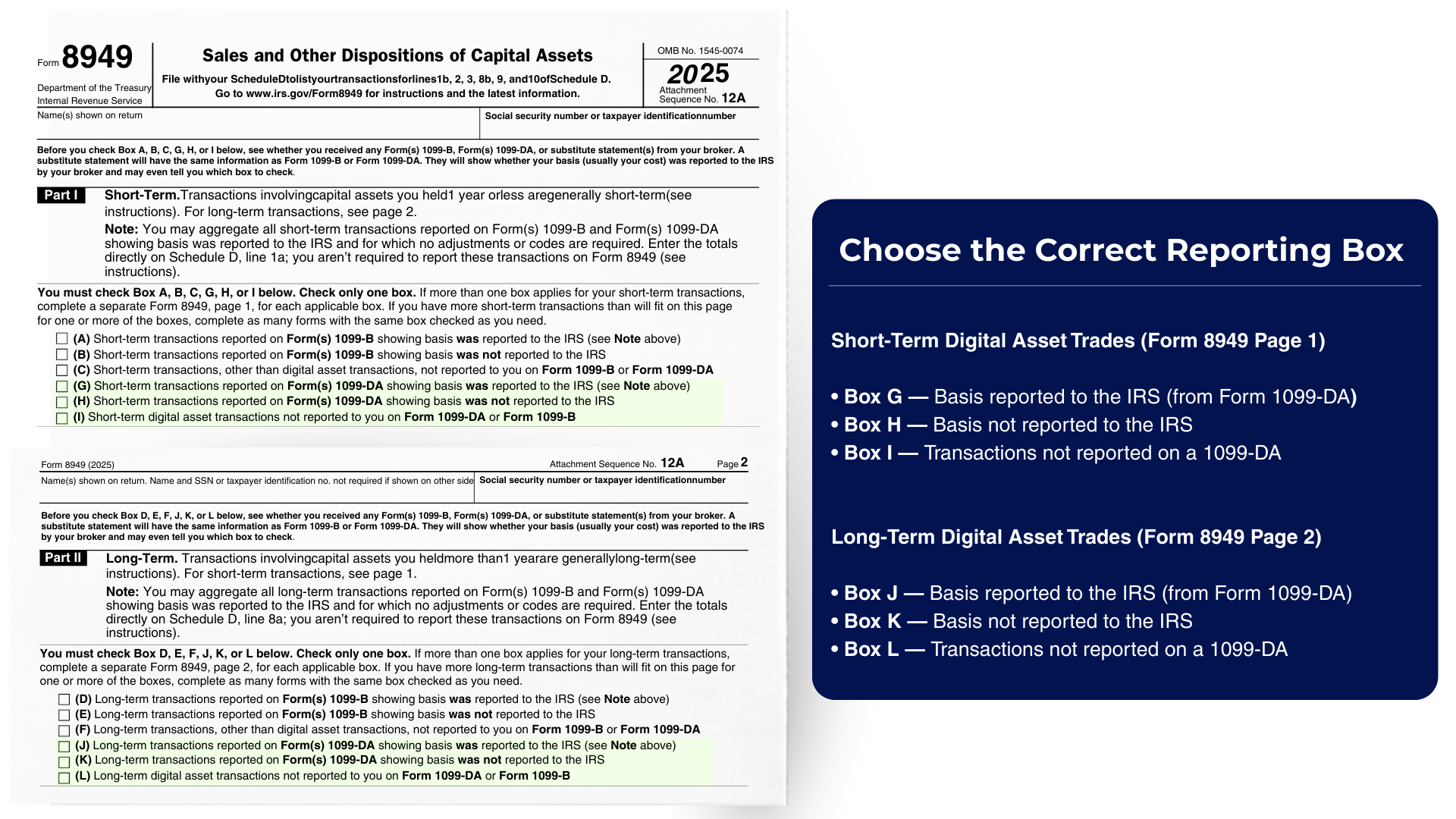
Until now, you used boxes A, B, C for short-term and D, E, F for long-term. Those boxes were designed for stocks. Crypto got squeezed into the same categories.
The IRS added new boxes: G, H, I for short-term digital assets and J, K, L for long-term digital assets.
Crypto now gets its own section. The IRS can distinguish between your stock trades and your crypto trades. They can see the total proceeds from digital assets separately.
This separation is significant. It means the IRS is tracking crypto as its own asset class with dedicated matching protocols.
Why Did the IRS Separate Digital Assets from Stocks?
Before this change, crypto transactions were blended into the same boxes as stocks and bonds. The IRS couldn't tell which proceeds came from Coinbase and which came from your brokerage account.
Now they can.
When your 1099-DA arrives from Coinbase or Kraken or Gemini, the IRS will compare those totals directly against the proceeds you report in boxes G, H, I, J, K, L.
The proceeds column on Form 8949 is column D. It shows the sale price for each transaction. This is the column the IRS is targeting.
They're going to add up every number in that column under your crypto boxes. Then they're going to compare it to the total proceeds reported on your 1099-DAs.
If the numbers don't match, you're flagged.
How Will the IRS Match Your 1099-DA Against Form 8949?
Your 1099-DA will list every sale, exchange, and transfer you made. Not just a bottom-line total. Every single transaction.
Coinbase reports 147 transactions? You'll see 147 line items on your 1099-DA.
The IRS will take the proceeds total from your Form 8949 and match it against the proceeds total from all your 1099-DAs combined.
Here's the key: they want to see at least as much reported on your Form 8949 as what brokers reported on your 1099-DAs.
What If Your 1099-DA Cost Basis Is Wrong?
Here's where it gets messy.
Your 1099-DA will show cost basis for some transactions. Often that cost basis is inaccurate.
Brokers don't track transfers between wallets. They don't know what you paid for Bitcoin in 2019, or that you moved it to cold storage and brought back in 2024.
But you still have to report those 1099-DAs on Form 8949. Even when the cost basis is wrong.
Different CPAs handle this differently. Some adjust the cost basis on the same line. Some add explanatory statements. Some file amended forms later.
The correct approach depends on how the broker reported it and whether they left cost basis blank or filled it incorrectly. This is where professional tax preparation becomes critical.
We'll know more once we see actual 1099-DAs from the major exchanges in early 2026. But the principle remains the same: your total proceeds must account for every transaction the IRS expects to see.
Is Crypto Privacy Dead?
The IRS is calling them "cryptocurrencies" on official forms. But there's very little crypto left in cryptocurrency.
The only thing hidden now is your private keys on the blockchain. Everything else is visible.
Form 8949 isolates your digital asset activity. 1099-DAs report every transaction brokers see. And in 2027, CARF (Crypto Asset Reporting Framework) kicks in.
CARF is a global reporting standard. Countries will share crypto transaction data across borders. If you trade on a foreign exchange, that exchange will report your activity to your home country.
The IRS will see trades you made in Singapore, London, Dubai. They'll cross-reference those against what you reported on Form 8949.
Crypto isn't becoming more regulated. It's becoming fully visible.
Key Takeaways
The IRS created separate Form 8949 boxes for crypto. Boxes G, H, I for short-term digital assets and J, K, L for long-term. Stocks stay in the old boxes. This lets the IRS isolate crypto proceeds for automated matching.
Your Form 8949 proceeds total must match or exceed the totals reported on your 1099-DA forms. The IRS will compare column D (proceeds) on your Form 8949 against every 1099-DA brokers send them. Missing even one transaction triggers an audit flag.
You must report your 1099-DA even when the cost basis is wrong. Brokers often report inaccurate cost basis for transfers and wallet movements. You can't skip the transaction. You have to report it and correct the basis.
CARF reporting could start in 2027. If the White House signs the executive order to join the international Crypto Asset Reporting Framework (CARF), foreign exchanges will report your trades to the IRS. If you traded in Singapore, London, or Dubai, those transactions will show up in IRS systems whether you report them or not.
Professional preparation eliminates matching errors before filing. One proceeds mismatch costs more in penalties and CPA fees to fix than getting it right the first time.
FAQ: Form 8949 and 1099-DA Matching for Crypto
Q: Do I need to report crypto separately from stocks on Form 8949 now?
A: Yes. Starting with your 2025 tax return filed in 2026, crypto goes in boxes G, H, I for short-term and J, K, L for long-term. Stocks stay in boxes A, B, C and D, E, F. The IRS will match your crypto totals against 1099-DA reports.
Q:What happens if my Form 8949 total doesn't match my 1099-DA?
A:Automatic audit flag. The IRS computer compares proceeds totals. If you reported less than what brokers sent them, they'll send a CP2000 notice asking why. CryptoTaxAudit reconciles these totals before you file.
Q: Can I ignore my 1099-DA if the cost basis is wrong?
A: No. You must report every transaction shown on your 1099-DA. You can correct the cost basis, but you can't skip reporting the transaction entirely. The IRS expects to see those proceeds on your Form 8949.
Q:What if I made trades on foreign exchanges?
A:Report them. CARF reporting starts in 2027. Foreign exchanges will send your transaction data to the IRS. If you leave it off your Form 8949, the IRS will catch it when they receive CARF reports.
Q: Should I file my own crypto taxes or hire a CPA?
A: If you made more than 10 transactions or traded on multiple platforms, professional preparation eliminates matching errors before they become audit triggers. One proceeds mismatch costs more in penalties and CPA fees to fix than getting it right the first time.
The IRS Is Getting Granular About Crypto Reporting
Form 8949 now tracks digital assets separately. 1099-DAs report every transaction. CARF will close the foreign exchange gap.
The IRS built this system to catch unreported gains. The matching happens automatically. The audit letters go out before you even know there's a problem.
Your job is to report accurately. Account for every transaction brokers reported. Make sure your proceeds total equals or exceeds what the IRS expects to see.
CryptoTaxAudit exists to handle this before it becomes an audit. We reconcile 1099-DAs, structure Form 8949 correctly, and account for every transaction the IRS will match.
Author