
The Crypto Wash Sale Trap: Harvest Losses the Safe Way
Every November, crypto investors run the same play. Sell a coin that's down, lock in the loss, and buy it right back. You keep your position and get a loss to offset your gains.
For years, that was perfectly legal, because the wash sale rule covered only stocks and securities.
That may be about to change. The Digital Asset Tax Certainty Act (H.R. 10357) would extend the wash sale rule to crypto. As written, it would apply to sales after September 14, 2026, the day the bill was introduced. If it passes in that form, the losses you harvest this year could be disallowed after the fact.
Key Takeaways
- This is still a proposal. It could change or never pass. The Digital Asset Tax Certainty Act (H.R. 10357) would extend the wash sale rule to crypto.
- As written, it would apply to sales after September 14, 2026, the day the bill was introduced. If it passes in that form, the losses you harvest this year could be disallowed after the fact.
- You have a wash sale when you sell at a loss and buy the same or a "substantially identical" asset within 30 days before or after the sale. That's a 61-day window.
- The bill also treats wrapped and tokenized versions of a coin as substantially identical. Selling BTC and buying WBTC won't work.
- Wait 31 days to rebuy. It's the simplest rule. Sell, wait 31 full days, then buy back.
- Document everything. Keep dated records of each sale and purchase across all platforms. If the IRS questions a loss, the timeline is your defense.
How the Wash Sale Rule Works
You have a wash sale when you sell at a loss and buy the same or a "substantially identical" asset within 30 days before or after the sale. That's a 61-day window.
When the rule applies, your loss is not allowed this year. It is added to the cost basis of the coins you bought back. You only get the benefit when you finally sell those coins in a transaction that isn't itself a wash sale.
The bill also treats wrapped and tokenized versions of a coin as substantially identical. Selling BTC and buying WBTC won't work.
An Example: An $80,000 Loss That Vanishes
Take Sarah, an active trader. In March, she sold Solana for an $80,000 short-term gain.
By November, her Ethereum position is down $80,000. She sells the ETH on November 20, buys it back on November 21, and expects to pay zero tax assuming that Solana gain was completely offset by the Ethereum loss.
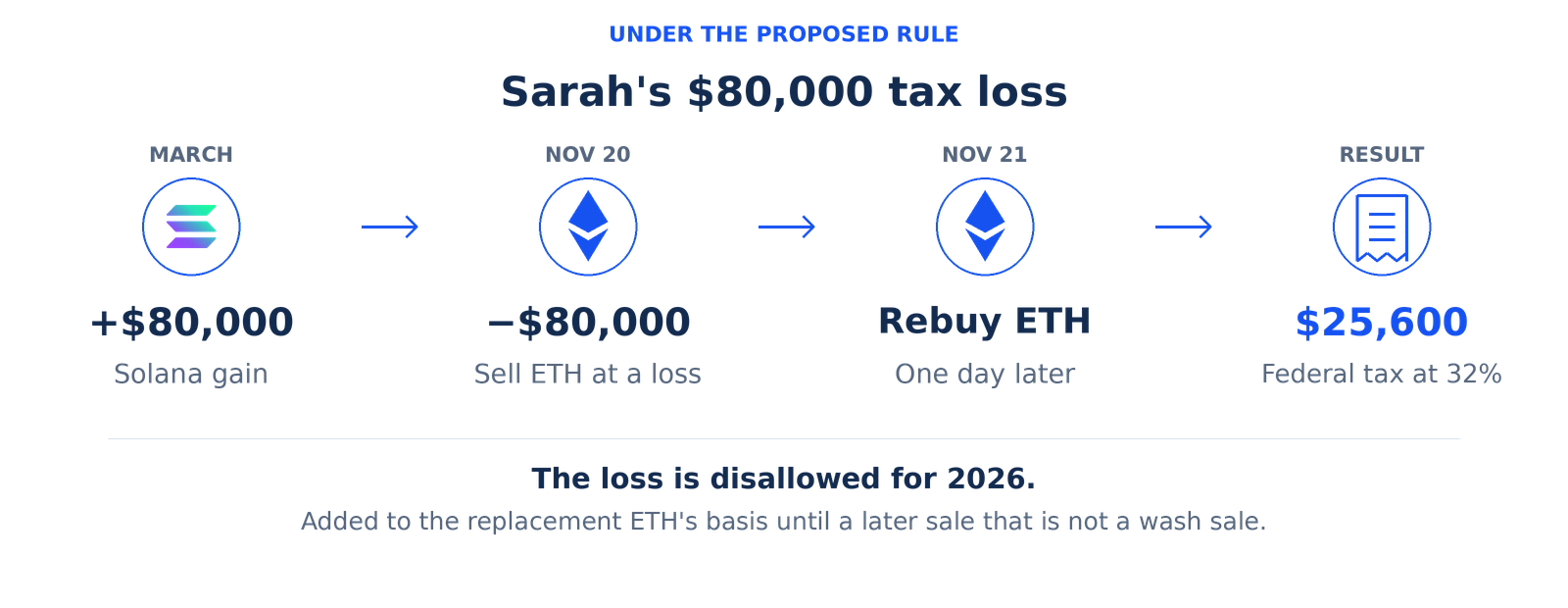
Under the proposed rule, here's what actually happens:
- Her $80,000 loss is disallowed for 2026.
- Her $80,000 Solana gain is fully taxable. At a 32% bracket, that's about $25,600 in federal tax she didn't plan for.
- The loss is pushed into her new ETH. She can't use it until she sells, and only if that sale doesn't trigger another wash sale.
If Sarah keeps holding for years, the loss stays trapped. And if she bought the replacement ETH in her IRA, the loss may be gone permanently. Under the IRS's position for stocks, the disallowed loss doesn't carry into a retirement account at all.
One quick rebuy, one five-figure tax bill.
The Hidden Traps
Most wash sales won't come from a deliberate rebuy. They'll come from things investors don't think about:
- Recurring buys. A weekly auto-purchase of the coin you just sold is a repurchase. The bill exempts staking and mining rewards, but not your own dollar-cost averaging.
- Other wallets and exchanges. The rule looks at all your accounts. Selling on Coinbase and buying on Kraken is still a wash sale.
- The 30 days before the sale. Buying more ETH in late October, then selling an older ETH lot at a loss in November, can trigger the rule.
- Your spouse's account. Under IRS rulings for stocks, purchases by your spouse can count.
New Guidelines for Crypto Tax Loss Harvesting
If you plan to harvest losses while this bill is pending, here's how to do it safely:
- Wait 31 days to rebuy. It's the simplest rule. Sell, wait 31 full days, then buy back.
- Check the 30 days before you sell. Look back across every wallet and exchange. If you bought the same coin recently, sell those newer lots first, or wait.
- Pause automatic purchases. Turn off recurring buys of any coin you're harvesting until the 61-day window closes.
- Swap into a different asset, not a wrapped one. Selling BTC and buying ETH keeps you in the market without buying the same asset. Selling BTC for WBTC or a BTC token does not.
- Keep the rebuy out of your IRA and your spouse's accounts. Coordinate as a household.
- Harvest early. Don't wait for the last week of December. Starting in October or November gives you room to wait 31 days and still rebuy before year-end.
- Document everything. Keep dated records of each sale and purchase across all platforms. If the IRS questions a loss, the timeline is your defense.
Don't Panic, but Plan
This is still a proposal. It could change or never pass. But because it reaches back to September 14, the safe move this year is to harvest as if it were already law.
If you have large losses to harvest or large gains to offset, book a consultation with our team. We'll map out your sales and replacement purchases so your losses actually count.
Author