The IRS Letter That Was Not From the IRS: How the Fake Digital Asset Compliance Portal Scam Works
By Clinton Donnelly, LLM, EA | CEO & Founder, CryptoTaxAudit
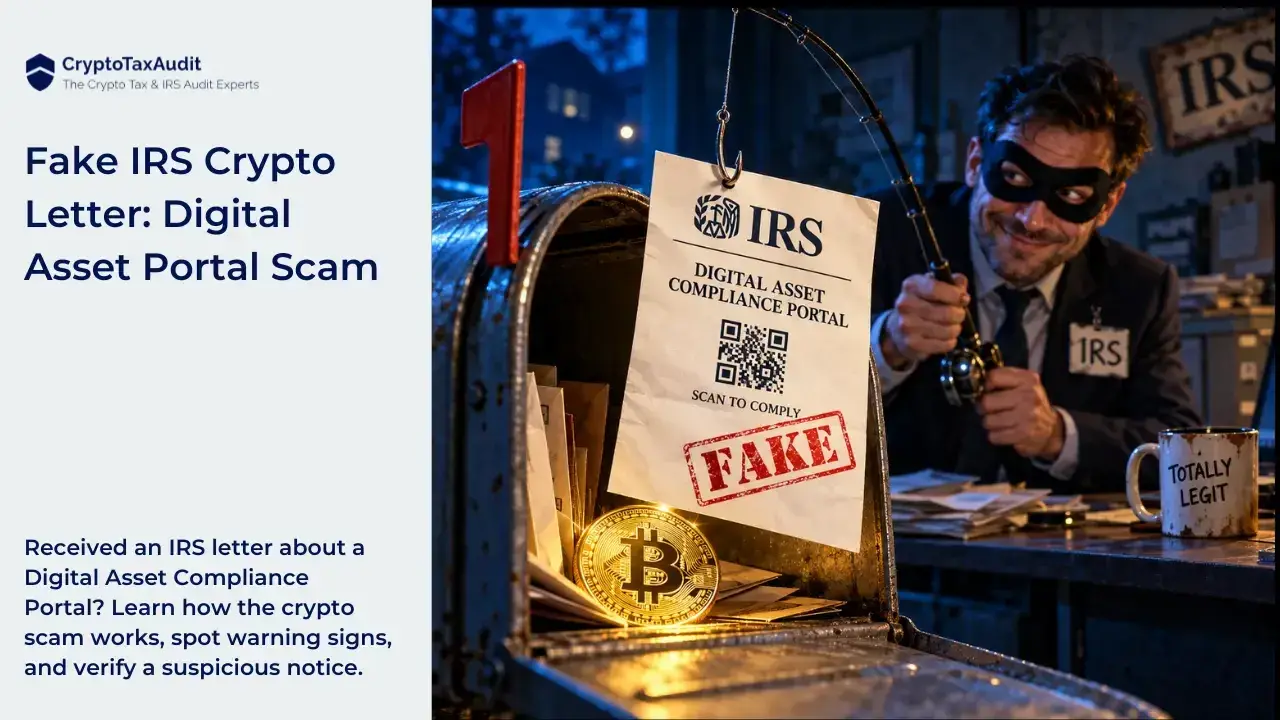
A plain white envelope arrives at a home address. No certified mail sticker, no red tape. Inside is one sheet of paper headed Department of the Treasury, Internal Revenue Service, Austin, Texas.
The name is printed correctly. The address is printed correctly. There is a notice number in the corner, a tax year range of 2017 through 2026, and a deadline. The letter says the recipient must enroll in a "Digital Asset Compliance Portal" before that date, and it provides a QR code to do it.
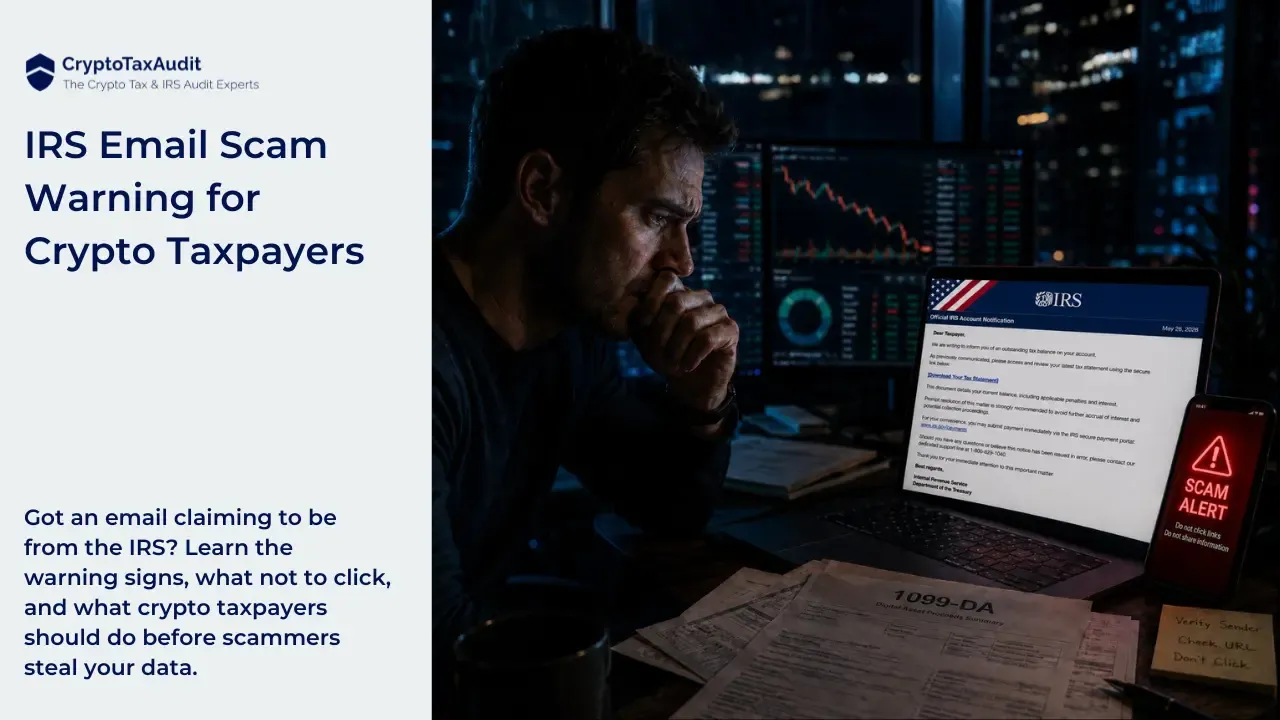
The IRS did not send this letter. On July 30, 2026, IRS Criminal Investigation issued a fraud alert confirming the portal does not exist. But the letter is well built, and the people receiving it are not careless. This post walks through how the scam works, screen by screen, and how to tell a real IRS crypto notice from this one.
Key Takeaways
- The Digital Asset Compliance Portal does not exist. IRS Criminal Investigation said so in a fraud alert on July 30, 2026. The IRS does not operate any enrollment portal and never requires taxpayers to register wallets or exchanges.
- The scam borrows the CP14 notice number. CP14 is the IRS's first balance-due notice, mailed to more than 8 million taxpayers a year. The fake letter used "CP14-432RA" to look familiar.
- A QR code does not prove a letter is fake. Real CP14 notices have included QR codes since October 2020, per news release IR-2020-233. The difference is where the code goes.
- The fake website is a profiling funnel. It asks which exchange or wallet you use, how much crypto you hold (up to $ 100,000), and your phone number for a "verification" call.
- The phone call is the real attack. In a vishing call, the scammer uses the harvested details to ask for a 2FA code, password, or seed phrase, or reads you a "new" seed phrase for a wallet they control.
- Verify at irs.gov, not through the letter. Type irs.gov into your browser yourself and sign in to your IRS Online Account. If the notice or balance is real, it is listed there.
What the Fake IRS Crypto Letter Looks Like
The fake IRS crypto letter is a single printed page styled as a notice from the Department of the Treasury, Internal Revenue Service, Austin, TX. It carries a CP14-style notice number, a tax year range of 2017 through 2026, an enrollment deadline, and a QR code.
It arrives in a plain envelope. It sits in the mailbox between a utility bill and a grocery flyer. Coinbase Security, working with the threat intelligence firm DarkTower, published the letter on July 28, 2026 after a customer reported it. Two days later, IRS Criminal Investigation issued its own alert.
The person who reported it is anonymous in every published account. For this post, call him Ray. Ray is not elderly and not careless. He stood in his kitchen with his phone in his hand and almost scanned the code. He got suspicious about the portal and made a phone call instead.
That report is the only reason the rest of the funnel was documented. Almost nobody stops.
Why a CP14 Notice Number Makes the Letter Convincing
CP14 is the most common notice the IRS mails. It is the first balance-due notice, sent when a taxpayer files a return and still owes money, and the IRS sends more than 8 million of them every year.
Anyone who has ever owed the federal government a dollar has probably held one. Somebody picked that number on purpose. They took the notice that reaches more American mailboxes than any other, put it at the top of a page carrying a real name and a real address, and added a deadline.
Coinbase notes the notice number and dates may change from letter to letter. The presence of a notice code does not verify a letter. Scammers copy real-looking numbers, Treasury addresses, and formatting because those details are exactly what a recipient checks first.
What Happens When You Scan the QR Code
The QR code on the fake letter leads to a lookalike domain, not irs.gov. The address is built so the letters I-R-S sit at the very front, with the real domain hiding behind them. Coinbase documented it as irs.digitalcomplianceportal[.]com.
On a phone screen at the end of a workday, it reads correctly. The page shows a blue banner reading "Official website of the United States government." The seal is right. The typeface is right. There is a "Get Started" button with a countdown to the enrollment deadline above it.
Screen 1: Where do you keep your crypto? A list of checkboxes: Ledger, Trezor, Coinbase, Kraken, Binance. No government agency needs to know the brand of your hardware wallet. This step tells the scammer which platform to impersonate later.
Screen 2: How much do you have? Not a number field. A set of ranges that climb to "more than $100,000." This is not how tax reporting works. A gain is a number. It comes off cost basis and proceeds and goes on Form 8949. IRS tax reporting does not ask taxpayers to pick a bracket describing their wealth. This step ranks targets by value.
Screen 3: Provider approval. The portal says it needs to obtain approval from your provider and you will be redirected. There is no redirect. This screen exists to make the next step feel routine.
Screen 4: Your phone number. The site asks for a number so a representative can verify you. You tap continue and nothing happens. No confirmation, no reference number, no receipt. When DarkTower's investigators entered a burner number, the site went dark on them too.
That leaves one open question. Does the phone ring later?
The Phone Call: How Vishing Turns a Phone Number Into a Stolen Wallet
Vishing, or voice phishing, is the follow-up attack that a data harvest like this sets up. Coinbase describes it as one of the most effective account-takeover techniques used against crypto holders today.
No transcript of a call from this campaign has been published. The pattern is well documented. The caller sounds calm, slightly bored, the way real government employees sound. He has your address because you answered a mailing. He knows your exchange from screen one. He knows roughly what you hold from screen two. You are not surprised he is calling because screen three told you he would.
Then he needs to verify the account. He asks for the code that just landed on your phone, or a password, or the twelve words.
The version that catches careful people works the other way around. The caller does not ask for your seed phrase. He gives you one. He says your wallet has been compromised, he is sorry, this happens more than people realize, and he will help you move everything somewhere safe right now. He reads you a fresh recovery phrase. You set up the new wallet and move your crypto into it with your own hands.
You hang up feeling like you handled it. You have transferred your entire portfolio into a wallet a stranger controls, voluntarily, and thanked him for it.
Nobody legitimate will ever ask you for a seed phrase. Nobody legitimate will ever hand you one. Not the IRS, not an exchange, not support. There are no exceptions.
Who Built the Scam
DarkTower traced the lookalike domain to a registrar in Hong Kong. It was registered days before the letters went in the mail. The site was hosted in Romania on a network already known for hosting phishing pages built to imitate banks and delivery companies.
This was not one person with a printer. It required physical mail, print production, address data on crypto holders, a cloned federal website, a scripted profiling funnel, and a call operation on the back end.
In the July 30 alert, IRS-CI Chief Jarod Koopman said criminals keep exploiting public trust in government agencies with fake websites and official-looking correspondence. Notice the direction this moved. Years of security training taught people not to trust email, so the attack went back to the mailbox, the one channel most people still believe.
Why a QR Code Does Not Prove an IRS Letter Is Fake
Real IRS CP14 notices have carried QR codes since October 2020. The IRS announced the change in news release IR-2020-233 so taxpayers could scan the notice and land on their own IRS.gov account instead of sitting on hold.
Those codes are on real notices today. Many warnings about this scam treat the QR code itself as the red flag. It is not. A QR code on an IRS letter does not prove the letter is fake.
When Ray stood in his kitchen, he was not looking at an obvious forgery. He was looking at the one notice number that reaches 8 million households, carrying the one feature the IRS itself spent nearly six years training people to trust. That is not luck. That is research.
The tell is not whether the code exists. The tell is where it goes. A real code lands on irs.gov. This one does not.
Real IRS Crypto Letters vs. the Scam
The IRS does send real letters about cryptocurrency. Letters 6173, 6174, and 6174-A are compliance letters sent to taxpayers with known digital asset activity, and CP2000 notices go out when what a taxpayer reported does not match what an exchange filed.
Those letters land in real mailboxes. CryptoTaxAudit's account team handles them every week. So the problem cannot be solved by assuming every IRS envelope about crypto is a scam.
It is solved by knowing what a real one never does.
- A real IRS notice never asks you to enroll or register your wallets or exchanges. There is no Digital Asset Compliance Portal. The IRS has stated flatly it does not operate one.
- A real IRS notice never asks which platform you use or how much crypto you hold. Tax reporting works from transaction records, not self-declared brackets.
- A real IRS notice never sends you to a website other than irs.gov. Any lookalike address is a fake, no matter how the page looks.
- Nobody from the IRS will call and ask for a code, a password, or a recovery phrase. Not to verify you, not to protect you, not for any reason.
If a letter does any of these, it is a scam.
How to Verify and Report a Suspicious IRS Letter
To verify an IRS notice, type irs.gov into your browser yourself and sign in to your IRS Online Account. Copies of IRS notices and any balance due appear there. If the notice is not in your account, do not act on the letter. Confirm through the contact details published on irs.gov.
Do not scan the code, not even to see where it goes. Curiosity is the attack surface.
Report it. File a tip with IRS Criminal Investigation at IRS.gov/submitatip (linked from the IRS-CI fraud alert), report the fake communication through the IRS impersonation reporting page, and file with the FTC at reportfraud.ftc.gov. Keep the letter and any screenshots.
If you already entered information or spoke with someone:
- Change your exchange password right now.
- Confirm your two-factor method inside the official app, not through any link someone sent you.
- Do not take incoming "verification" calls about the letter.
- Contact your exchange through its official support channel, not a number anyone gave you.
- Never move crypto to a "new" or "safe" wallet because someone told you to.
The reason this scam works is not that the letter is perfect. It arrives on the one subject where many crypto holders already feel exposed. Reporting is messy. There were wallet transfers never reconciled. An exchange sent a form that was not fully understood and the return was filed anyway. When a letter shows up saying the government wants to fix something, part of the reader already believes it. The target is uncertainty, not intelligence.
Ray got lucky. He was suspicious of the right thing on the right day. The better position is one where a letter like that cannot move you at all, because you already know what your reporting looks like and who picks up the phone if the real IRS writes. That is what Tax Shield membership is built for.
Frequently Asked Questions About Fake IRS Crypto Letters
Q: I got a letter from the IRS about my crypto with a QR code. Is it a scam?
A: If the letter tells you to enroll or register in a Digital Asset Compliance Portal, verify your holdings, or scan a code before a deadline, it is a scam. Do not scan the code. Verify the notice by typing irs.gov into your browser and checking your IRS Online Account. Real IRS crypto letters exist, but they never ask you to enroll wallets or exchanges.
Q: Is the IRS Digital Asset Compliance Portal real?
A: No. IRS Criminal Investigation confirmed in its July 30, 2026 fraud alert that the IRS does not operate a Digital Asset Compliance Portal. Any letter, QR code, or website promoting one is fraudulent.
Q: The letter has notice number CP14-432RA. Doesn't that make it real?
A: No. CP14 is a real notice type, which is exactly why the scammers used it. A notice number, a Treasury address, and official formatting can all be copied. The presence of a notice code does not verify a letter. Your IRS Online Account does.
Q: Does the IRS put QR codes on real notices?
A: Yes. Since October 2020, under news release IR-2020-233, real CP14 balance-due notices have included QR codes that link to IRS.gov. A QR code alone does not prove a letter is fake. The question is whether the code lands on irs.gov or on a lookalike domain.
Q: Which IRS crypto letters are real?
A: The IRS sends Letters 6173, 6174, and 6174-A to taxpayers with known digital asset activity, and CP2000 notices when reported income does not match what an exchange filed. These are real and should be answered. A real notice can be confirmed in your IRS Online Account and will never send you to a site other than irs.gov.
Q: I scanned the code and entered my information. What should I do now?
A: Assume the information is compromised. Change your exchange password immediately, confirm your two-factor method inside the official app, and contact your exchange through its official support channel. Do not accept any incoming call claiming to verify the letter. Keep the letter and screenshots, and report it to IRS-CI and the FTC.
Q: Should I call the phone number on the letter or check irs.gov?
A: Check irs.gov. Never call a number printed on a suspicious letter or entered on a suspicious website, because the scammer controls that line. Sign in to your IRS Online Account or use the contact details published on irs.gov. If the IRS actually needs something from you, it will be reflected in your account or confirmable through official IRS channels.
Q: Need help with a real IRS crypto notice?
A: If you have a genuine Letter 6173, 6174, 6174-A, or CP2000 about your crypto, CryptoTaxAudit's team reviews these every week. Get your IRS letter reviewed to understand what it means and how to respond.
Author