Why the IRS Prefers Tax Evasion Charges Over Tax Audits (And Why That Should Terrify You)
By Clinton Donnelly, CEO, Founder | CryptoTaxAudit
Pull up a Bitcoin chart from October through November. Watch the red candles stack up, day after day. Every morning: down another 3%, another 5%, another 8%.
Now pull up Zcash volume. The bars spike vertically. The price shoots up 10x in eight weeks.
That's not normal market behavior. That's fear of moving money.
Here's my tax perspective on what's driving this and why it matters more than you think.
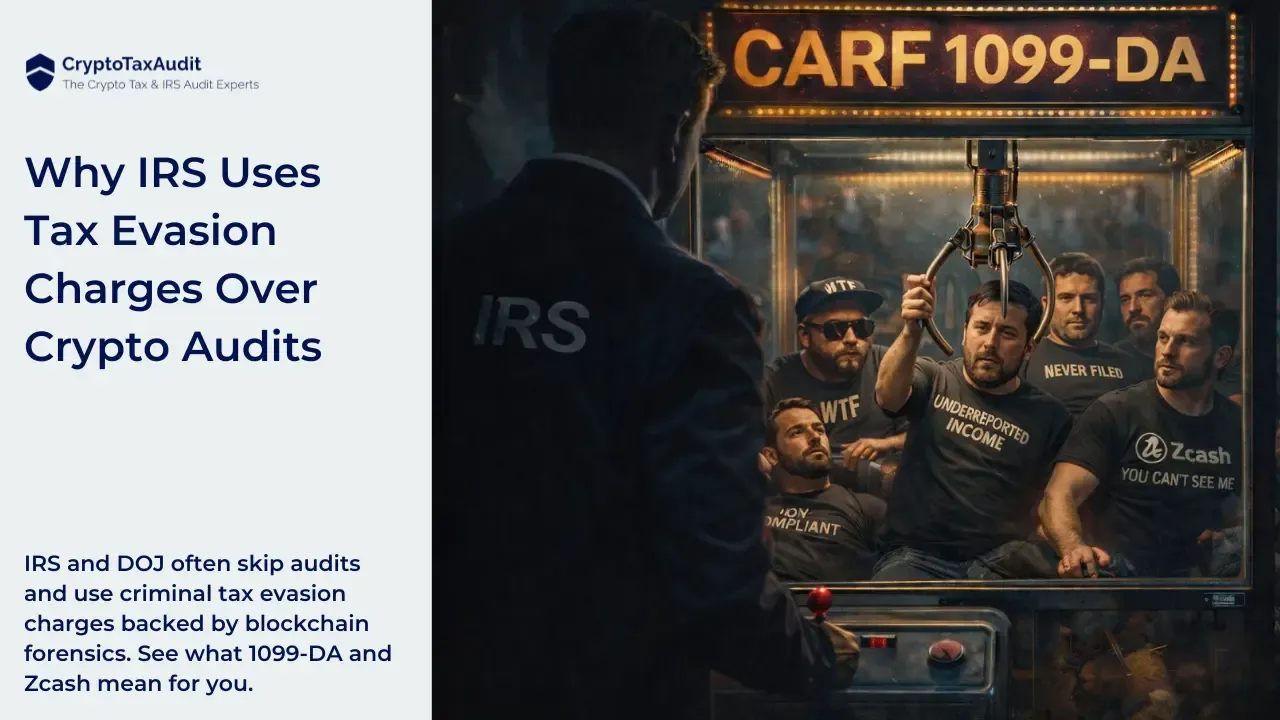
The tax authorities aren't coming after crypto holders with traditional audits. They're using tax evasion charges. It's faster. It's easier to prove. And it carries criminal penalties that make people settle immediately.
Roger Ver just settled for a reported $50 million in October 2025. The DOJ traced his Bitcoin movements back 10 years using blockchain forensics. They charged him with tax evasion.
Now, OG investors are watching the release of the Form 1099-DA in January 2026. They're watching CARF roll out to foreign exchanges. They know that a single transaction on a centralized exchange exposes their entire wallet history.
So they're panic-swapping into Zcash, a privacy coin, thinking it will hide their tracks.
But here's what they're missing: using privacy coins to move unreported assets creates MORE money laundering exposure, not less.
The IRS doesn't need to audit you. They just need to show you structured transactions to evade reporting. That's a criminal charge. And you'll settle to avoid prison.
Key Takeaways
- Tax authorities prefer tax evasion charges because they're easier to prove than traditional tax audits, using blockchain forensics and pattern analysis
- Roger Ver's October 2025 settlement showed the DOJ can trace Bitcoin addresses back 10+ years and combine tax evasion charges for maximum pressure.
- Form 1099-DA (January 2025) and CARF (2026) will force exchanges to report wallet addresses, potentially exposing OG holders who haven't reported historical transactions.
- One wallet exposure on a centralized exchange allows the IRS to map your entire transaction history across multiple wallets you thought were disconnected
- Privacy coin strategies create additional criminal exposure the IRS traces around Zcash by showing unexplained asset sources, which triggers structuring charges
- Most traders who started before 2020 have unreported transactions because the rules weren't clear but voluntary disclosure prevents criminal charges if you file before they investigate
Why Tax Evasion Charges Are Easier to Prove Than Tax Audits
Traditional tax audits are slow. They're civil proceedings. You dispute the assessment. You negotiate penalties. It can take years.
Tax Evasion charges are criminal. They're fast. And they carry prison time.
Here's why the IRS prefers this approach for crypto:
Blockchain forensics makes the case easy to build. They identify your wallet address from one exchange transaction. They trace it back through years of activity. They map connections to other wallets. They reconstruct the entire portfolio sales you never reported, gains you never claimed.
You can't dispute the blockchain. In a traditional audit, you argue about cost basis, transaction dates, and fair market value. With blockchain forensics, the transactions are timestamped and permanent. The evidence is irrefutable.
Criminal tax evasion charges create immediate pressure to settle. Tax evasion is serious. Criminal charges are terrifying. The combination makes people settle fast rather than risk a trial.
Roger Ver settled for $50 million in October 2025. The charges: tax evasion. But the DOJ also described how they traced his wallet connections, implying structuring and money laundering patterns.
He settled rather than go to trial. That's the point.
Learn more about IRS cryptocurrency enforcement.
How the Roger Ver Case Changed Everything
Roger Ver's plea bargain sent shockwaves through the OG crypto community.
The government went back 10 years. They identified specific addresses that Ver controlled. They used "advanced mathematical sub-graphing techniques" to trace connections to other wallets. They reconstructed his entire portfolio history.
Sales that never appeared on his tax returns. Movements he thought were private. Connections between wallets, he thought, were separate.
He was dead to rights. He settled for an estimated $50 million.
OG Bitcoin holders saw this case and realized that the IRS now has a new playbook. They can trace decade-old activity. They can map your entire crypto history from a single wallet exposure.
Then came the next blow: Form 1099-DA.
Form 1099-DA and CARF: Why OG Holders Are Panicking
Form 1099-DA launches in January 2025, which is weeks away. Every U.S. exchange will report your transactions to the IRS. Your name. Your Social Security number. Your wallet addresses. Transaction amounts.
Then CARF rolls out to foreign exchanges over the next year. The Crypto Asset Reporting Framework forces international exchanges to report under automatic exchange agreements.
Here's what this means for anyone who's held crypto since 2017, 2018, 2019:
Once you use an old wallet address on an exchange, even to cash out a small amount, you've exposed that wallet to tax authorities. They know it's your wallet. From there, they can trace and connect all your other activities.
Who started trading in 2020 or earlier and reported everything accurately? Most people were unsure of how to do it. The rules weren't clear. Exchanges didn't send tax forms.
But unreported transactions are an indictable offense. They can come after you.
That's why you're seeing the Bitcoin selloff and the Zcash spike. Large crypto investors are trying to conceal their activities.
Why the Zcash Rollover Strategy Makes It Worse
Look at the volume charts. Bitcoin sells off. Zcash volume temporarily spikes, driving demand and creating that 10x price move in two months.
Large crypto investors are swapping Bitcoin for Zcash.
Zcash is a zero-knowledge cryptographic system for financial transactions. It's a soft fork off Bitcoin with shielded transactions—you can validate a trade without disclosing who the buyer and seller are, or how much was traded.
Supreme privacy token.
Here's the rollover strategy they're using:
- Swap Bitcoin for Zcash on Platform A
- Move Zcash to Platform B (shielded transaction)
- Convert Zcash back to Bitcoin or cash out on Platform B
They think this breaks the chain. They believe the IRS can't trace transactions through zero-knowledge protocols.
But the IRS doesn't trace through Zcash. They trace around it.
Platform A reports your Bitcoin-to-Zcash swap on a 1099-DA. That's a taxable event. Required reporting.
Then you appear on Platform B with new Bitcoin or other assets. Where did they come from?
You can't explain the source without admitting the Zcash transaction, which you likely didn't report.
That's when they can add structuring charges. 31 U.S.C. § 5324 covers structuring transactions to evade reporting requirements.
Now you're potentially facing tax evasion AND money laundering charges.
I noticed this pattern after seeing discussions online, including a video Andrew Tate posted in mid-November.
He claimed artificial intelligence is scanning blockchains and providing completed indictments to tax authorities. He said everyone involved in crypto will face tax avoidance and money laundering charges. His advice: "Zero knowledge proof privacy solutions. You need them now."
But using privacy coins to move unreported assets can create another potential money laundering issue.
If you're a crypto trader considering this strategy, you're between a rock and a hard place. They're going to find you one way or the other.
The difference is whether they find you through voluntary disclosure or through a criminal investigation.
If you need legitimate strategies for reporting historical cryptocurrency transactions,consult a cryptocurrency tax specialist before the IRS starts asking questions.
The Real Solution: Get Compliant Before They Find You
It's important for everyone to report all their income.
If you have prior years that you didn't report completely, you can amend those returns. There's a limit to how far back you can go, but the IRS allows voluntary disclosure.
Here's why timing matters:
Voluntary disclosure prevents criminal charges. If you come forward before they start an investigation, you avoid money laundering and criminal tax evasion charges. You'll owe back taxes, interest, and civil penalties, but not prison time.
Once they send a criminal referral, it's too late. After they've traced your wallets and built the case, voluntary disclosure is off the table.
Form 1099-DA and CARF create a deadline. Once exchanges start reporting your wallet addresses in January 2025, the IRS can begin tracing. The window for quiet compliance is closing.
This is where Tax Shield monitoring becomes critical.
Tax Shield tracks your wallet activity across platforms. It identifies unreported transactions. It alerts you to compliance gaps BEFORE they trigger IRS investigations or money laundering red flags.
Think of it as preventive enforcement protection. You catch the issues before the authorities do.
The IRS is using blockchain forensics and tax evasion charges because it's easier than traditional audits. Roger Ver proved they can go back 10 years. Form 1099-DA and CARF are closing the exits.
Don't make it worse by using privacy coins to hide. That creates additional criminal exposure.
Instead: Book a consultation. Map your unreported transactions. File amended returns for prior years. Get compliant before 1099-DA reporting starts.
The goal is to develop a plan to live in compliance. That way, you can keep more of your crypto instead of losing it to criminal settlements.
FAQ: Tax Evasion Charges and Crypto Tax Enforcement
Q: Why does the IRS prefer tax evasion charges over traditional tax audits for crypto cases?
A: Tax evasion charges are faster to prove using blockchain forensics and carry criminal penalties that pressure immediate settlements. Traditional tax audits are civil proceedings that can take years. The combination of tax evasion and money laundering charges creates maximum pressure to settle quickly, like Roger Ver's $50 million settlement. CryptoTaxAudit helps you avoid this scenario through proactive compliance.
Q: Can the IRS really trace my Bitcoin back 10 years like they did with Roger Ver?
A: Yes. The DOJ utilized "advanced mathematical sub-graphing techniques" to trace Roger Ver's wallet connections and reconstruct his portfolio history spanning a decade. Blockchain forensics companies like Chainalysis and Elliptic sell these capabilities to law enforcement. Once they have one wallet address tied to your identity from a 1099-DA report, they can map your entire transaction history.
Q: Does using Zcash or other privacy coins hide my transactions from the IRS?
A: No. The IRS doesn't need to trace through privacy coins, they trace around them. When you swap Bitcoin for Zcash on Platform A, that's a reported taxable event. When you reappear on Platform B with new assets, you can't explain the source without admitting the Zcash transaction you didn't report. This can trigger potential structuring charges under 31 U.S.C. § 5324.
Q: What is Form 1099-DA, and when does it start?
A: Form 1099-DA launches in January 2025. It requires U.S. exchanges to report cryptocurrency transactions to the IRS, including your name, Social Security number, wallet addresses, and transaction amounts. This gives the IRS starting points for blockchain forensics investigations.
Q: I didn't report crypto gains from 2017-2020 because I didn't know I had to. What should I do?
A: File amended returns through voluntary disclosure before the IRS starts an investigation. If you come forward first, you can avoid criminal charges and tax evasion allegations. You'll owe back taxes and penalties, but not prison time. Schedule a consultation with CryptoTaxAudit to map your exposure and file correctly.
Q: What's the difference between tax evasion and money laundering charges?
A: Tax evasion is failure to report income and pay taxes. Tax evasion includes structuring transactions to evade reporting requirements. The IRS can use both charges together in crypto cases because blockchain forensics can show transaction patterns that look like structuring, especially when privacy coins are involved.
Q: How does Tax Shield prevent tax evasion red flags before they start?
A: Tax Shield monitors your wallets for unreported transactions, tracks cost basis across platforms, and identifies compliance gaps before Form 1099-DA or CARF reporting triggers IRS scrutiny. It catches potential structuring patterns or unexplained asset sources that could trigger money laundering investigations. Learn more about Tax Shield.
Bottom line:
The IRS uses tax evasion charges because they're easier to prove than traditional tax audits. Blockchain forensics builds the case. Privacy coins make it worse, not better.
Voluntary disclosure prevents criminal charges but only if you file before they investigate.
If you have unreported crypto from prior years, file amended returns before Form 1099-DA reporting starts in January.
Related Articles: How the 1099-DA Tracks Private Wallets and Offshore Crypto Activity
Author