
Why Your 1099-DA Doesn't Match Your Tax Return
By Clinton Donnelly, LLM, EA | CEO & Founder, CryptoTaxAudit
With Form 1099-DA now in effect, U.S. exchanges report every sale, swap, and transfer you make to the IRS. Every single transaction. No minimum threshold. Every wallet address your exchange touched.
The IRS receives this data directly. If your tax return does not account for the activity shown on your 1099-DA forms, that discrepancy can trigger an automated notice or a full audit.
For traders who move assets between platforms or use decentralized exchanges, the picture gets complicated quickly.
The 1099-DA did not give investors clarity on what to report. It gave them a document they could not interpret.
Key Takeaways:
The IRS sees exchange activity: With Form 1099-DA now in effect, U.S. exchanges report every sale, swap, and transfer you make to the IRS. Every single transaction. No minimum threshold. Every wallet address your exchange touched.
One exchange can simplify the form: Keeping all trading activity on a single centralized exchange means the exchange can report your full cost basis, sale price, and gain on one 1099-DA form. That simplifies your tax return.
Multiple platforms create the mismatch: For traders who move assets between platforms or use decentralized exchanges, the picture gets complicated quickly.
The form still does not map cleanly: Even a 50-page 1099-DA may not contain a single number you can directly enter on Form 8949. The form reports raw transactions, not net taxable gains.
Off-exchange activity is not invisible: If the IRS opens an audit triggered by a 1099-DA discrepancy, agents will ask for your full transaction history, including decentralized exchange activity.
High-frequency traders need professionals: Do-it-yourself gain calculation software cannot handle the volume and complexity of active trading with accuracy.
What the IRS Can See From Your 1099-DA
Until now, the IRS has struggled to track your crypto trading.
That changed in January 2026 with the rollout of Form 1099-DA.
Every US-based centralized exchange will report three things to the IRS:
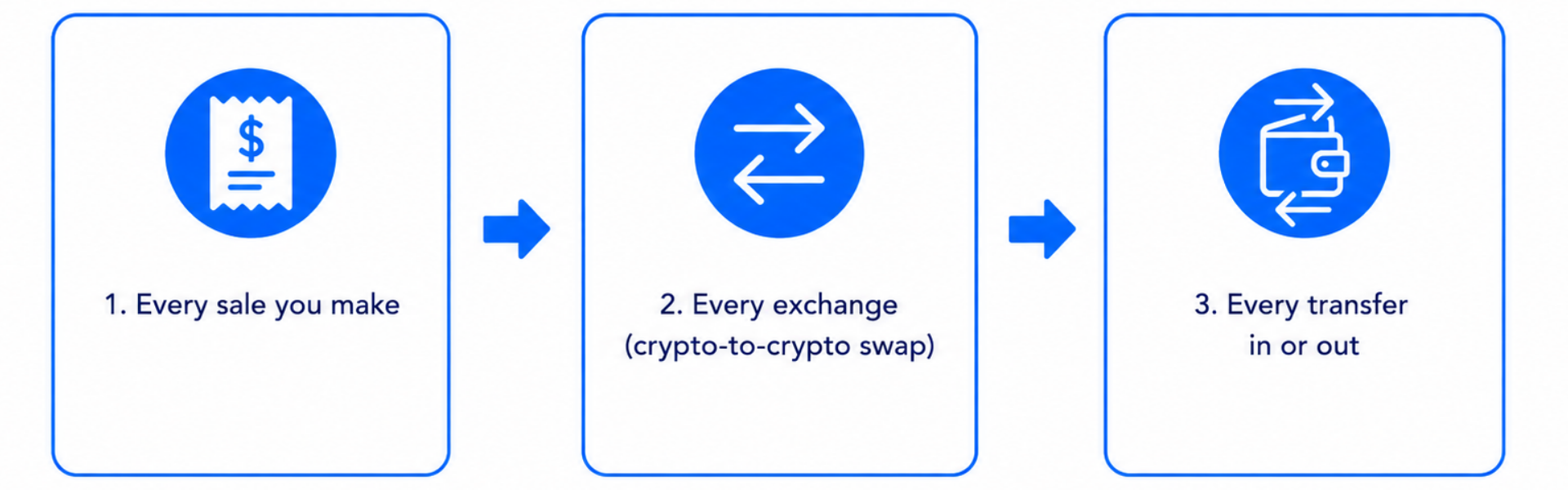
No minimum threshold exists. Transfer $1 worth of Bitcoin, and it gets reported.
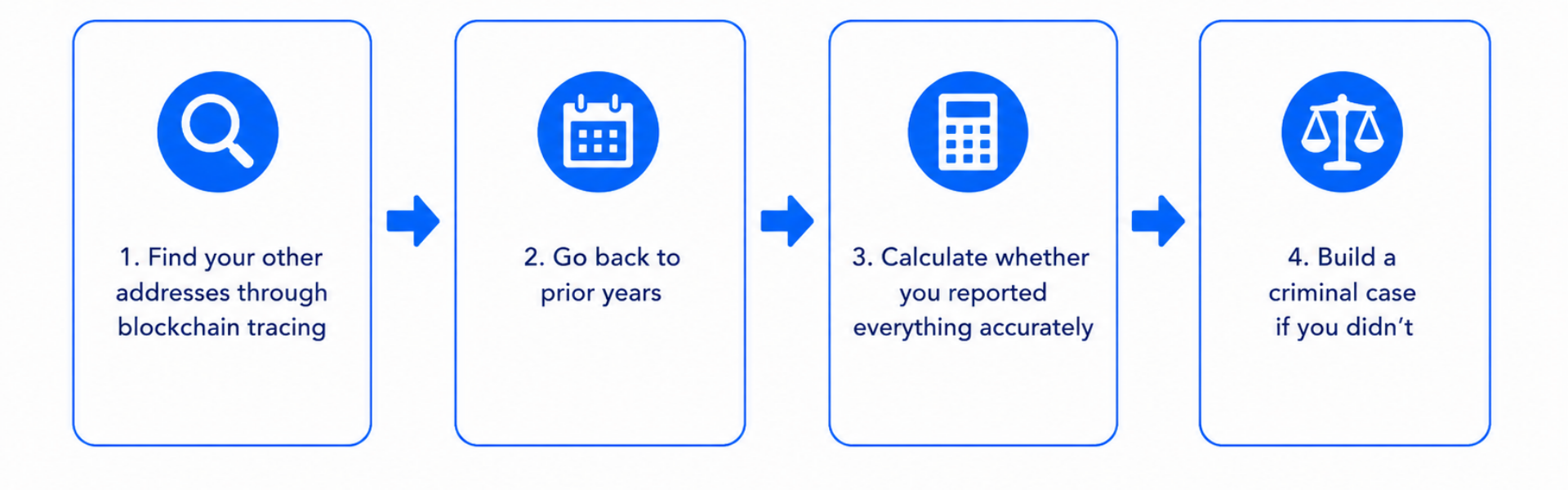
The transfer reporting is what matters most. The IRS will see exactly which wallet addresses you sent crypto to and which addresses sent crypto to you.
That's how they map your entire portfolio.
Why One Exchange Can Make Reporting Cleaner
For traders who use a single exchange for all buying, selling, and holding, the reporting picture is relatively clean. The exchange has all the data it needs to populate an accurate 1099-DA.
The simplest approach to 1099-DA compliance is to do all your trading on one centralized exchange. When you buy, sell, and hold in one place, that exchange knows your full cost basis for every asset. It can report your complete gain or loss history on a single 1099-DA form.
This is exactly how stock investing has worked for years. When you trade through a brokerage like Merrill Lynch or Fidelity, your 1099-B tells the whole story. One document, one platform, complete reporting.
For crypto, the appeal is the same: a single 1099-DA from one exchange makes your tax return straightforward. The numbers flow from the form directly onto Form 8949 and Schedule D.
Why One Exchange Still Creates a Risk Tradeoff
The problem is that this strategy requires trusting a centralized platform with your entire portfolio.
Recommending that high-frequency traders put everything on a single centralized exchange raises a practical problem: exchanges fail.
Over the past several years, major exchanges have collapsed, taking customer assets with them. FTX is the most prominent example, but it is not the only one. Celsius, Voyager, BlockFi, and others all failed, leaving customers in line with creditors.
For tax compliance purposes, the one-exchange strategy is simpler. For asset protection purposes, it creates concentrated custodial risk. Those two goals are in tension, and traders need to make that tradeoff deliberately.
Why Wallets, DeFi, and Swaps Still Matter
Many traders are unwilling to keep all their assets on a centralized exchange. The phrase is common in the crypto community: "not your keys, not your coins."
The alternative is to hold most assets in private wallets or on decentralized exchanges, and only use centralized exchanges for specific transactions, typically for converting to cash. Those on-ramp and off-ramp events will generate 1099-DA reports. But the bulk of trading activity stays off the centralized exchange reporting system.
This approach preserves your control over your assets. It also creates a more complicated tax picture.
Decentralized exchange transactions are still taxable. The IRS does not exempt peer-to-peer trades, DeFi swaps, or token-to-token exchanges from capital gains reporting just because no 1099 was issued. Every swap is a taxable event. You are responsible for tracking and reporting it.
Once the IRS gets a few of your wallet addresses from exchange reports, they can:
Why the Numbers Still Do Not Match Form 8949
The 1099-DA was designed with two goals: to inform the IRS of crypto transactions and to help taxpayers prepare accurate returns. It succeeded at the first and failed completely at the second.
Taxpayers are receiving 1099-DAs that are 20, 30, or even 50 pages long. None of those numbers is a figure they can enter directly on their tax return. The form breaks out transactions in ways that do not map to the line items on Form 8949 or Schedule D.
The IRS compounded this by adding new checkboxes for crypto trading on Form 8949. The result is confusion at every level.
The 1099-DA cannot do that because digital asset transactions require cost basis tracking, and the IRS chose not to require cost basis reporting in the first year of implementation. That decision removed the one piece of information that would have made the form useful.
What remains is a long document reporting transfer activity, purchase dates, and gross proceeds, across dozens of transaction categories, in formats that vary by exchange. Most taxpayers cannot identify what is taxable and what is not just by reading the document.
How a 1099-DA Mismatch Can Trigger a CP2000 or Audit
The IRS receives 1099-DA data from exchanges. It matches that data against tax returns automatically. If a trader's return does not reflect the activity reported on the 1099-DA, the system flags the discrepancy. That can generate a CP2000 notice or escalate to a full examination.
A CP2000 is issued when the income reported on a tax return does not match what the IRS received from third-party sources, including exchanges.
Once an audit is open, the scope expands. IRS agents do not stop at 1099-DA data. They request full transaction histories, a list of all exchanges the trader has used, and supporting documentation for cost basis claims. At that point, decentralized exchange activity comes into the picture.
If the agent discovers significant trading volume on decentralized platforms that was not reported, that becomes the primary audit issue. What started as a 1099-DA mismatch becomes a much larger inquiry into unreported gains.
This is why the off-exchange strategy requires meticulous record-keeping. Keeping assets off centralized exchanges does not protect a trader from audit exposure. It just means the trader has to have their own complete transaction history ready.
Why Professional Gain Calculation Becomes the Missing Layer
For traders with significant volume, the practical recommendation is to report all activity accurately, regardless of where it occurred. That means accounting for every 1099-DA from centralized exchanges and every taxable event on decentralized platforms.
Do-it-yourself crypto tax software struggles with high-frequency trading. The volume of transactions, the complexity of cost basis tracking across wallets and platforms, and the specific rules around wash sales and staking all create opportunities for error. For high-frequency traders, professional gain calculation is not a luxury. It is a risk management decision.
Tracking cost basis across multiple exchanges, wallets, and DeFi protocols is not feasible in a spreadsheet. It requires purpose-built tools and professional judgment.
In 95% of cases, investors who use a professional gain calculation service pay lower tax bills than those who attempt to calculate gains themselves. The difference comes from correctly identifying missed deductions, properly applying cost basis methods, and catching misclassified transactions that were being taxed when they should not be.
A bulletproof gain calculation gives two things: an accurate return and documentation to support it under examination. That is the standard a professional service is built to meet.
Frequently Asked Questions About 1099-DA Mismatches
Q: What is Form 1099-DA, and when does it apply to me?
A: Form 1099-DA is the IRS information return for digital asset transactions. Centralized exchanges began issuing these forms for the 2025 tax year. If you bought or sold cryptocurrency on a U.S.-based exchange, you will receive a 1099-DA reporting those transactions to the IRS.
Q: Does it help to keep everything on one exchange for tax purposes?
A: It simplifies your 1099-DA reporting. When one exchange holds all your activity, it can report your entire cost basis and gains on a single form, similar to how stockbrokers use Form 1099-B. The tradeoff is custodial risk. Centralized exchanges have failed in the past, with customers losing assets.
Q: Can I just use the numbers on my 1099-DA to file my tax return?
A: No. The 1099-DA reports transaction data, not net taxable gains. The numbers on the form do not map directly to any line on Form 8949 or Schedule D. You need to calculate your actual gains and losses using cost basis tracking, which the 1099-DA does not fully provide.
Q: Do I have to report crypto trades on decentralized exchanges if I did not get a 1099?
A: Yes. Every taxable crypto transaction must be reported, regardless of whether a 1099 was issued. Decentralized exchange swaps, token-to-token trades, and DeFi transactions are all taxable events under current IRS guidance. The absence of a 1099 does not change the reporting obligation.
Q: What happens if the IRS finds a mismatch between my tax return and my 1099-DA?
A: The IRS matches 1099-DA data against tax returns automatically. A discrepancy can generate a CP2000 notice asking you to explain the difference, or it can trigger a full examination. Once an audit is open, agents typically request your full transaction history across all platforms, including decentralized exchanges.
Q: Can I use TurboTax or crypto tax software to file if I am a high-frequency trader?
A: Do-it-yourself software can handle basic trading activity. For high-frequency traders with significant volume across multiple platforms and wallets, the risk of error is high. Cost basis tracking, multi-platform reconciliation, and transaction-level accuracy require professional-grade tools and review. An underreporting error can result in penalties of 20% to 40% of unpaid taxes.
Q: Is it worth hiring a professional for crypto gain calculation?
A: For investors with more than $10,000 in annual gains, a professional gain calculation typically pays for itself. In 95% of cases, professional review results in a lower tax bill than self-prepared returns, because professionals identify and correct errors in cost basis tracking and transaction classification that most investors miss.
Q: Should I consult a professional about my 1099-DA situation?
A: If you are a high-frequency trader, trade across multiple platforms, or have significant activity on decentralized exchanges, yes. The complexity is high enough that errors in self-prepared returns carry real financial risk. Schedule a consultation with CryptoTaxAudit to discuss your specific situation.
Related Articles
The IRS Is About to See Every Crypto Transaction You Make
The 1099-DA Is a Disaster for Crypto Taxpayers
Should Crypto Traders Keep Everything on One Exchange for 1099-DA Reporting?
Author