No IRS Commissioner, A Broken 1099-DA, And The Crypto Enforcement Mess Of 2026: A Conversation With Anthony Parent
By Clinton Donnelly, CEO, Founder | CryptoTaxAudit, with Anthony Parent, Founder | IRSMedic
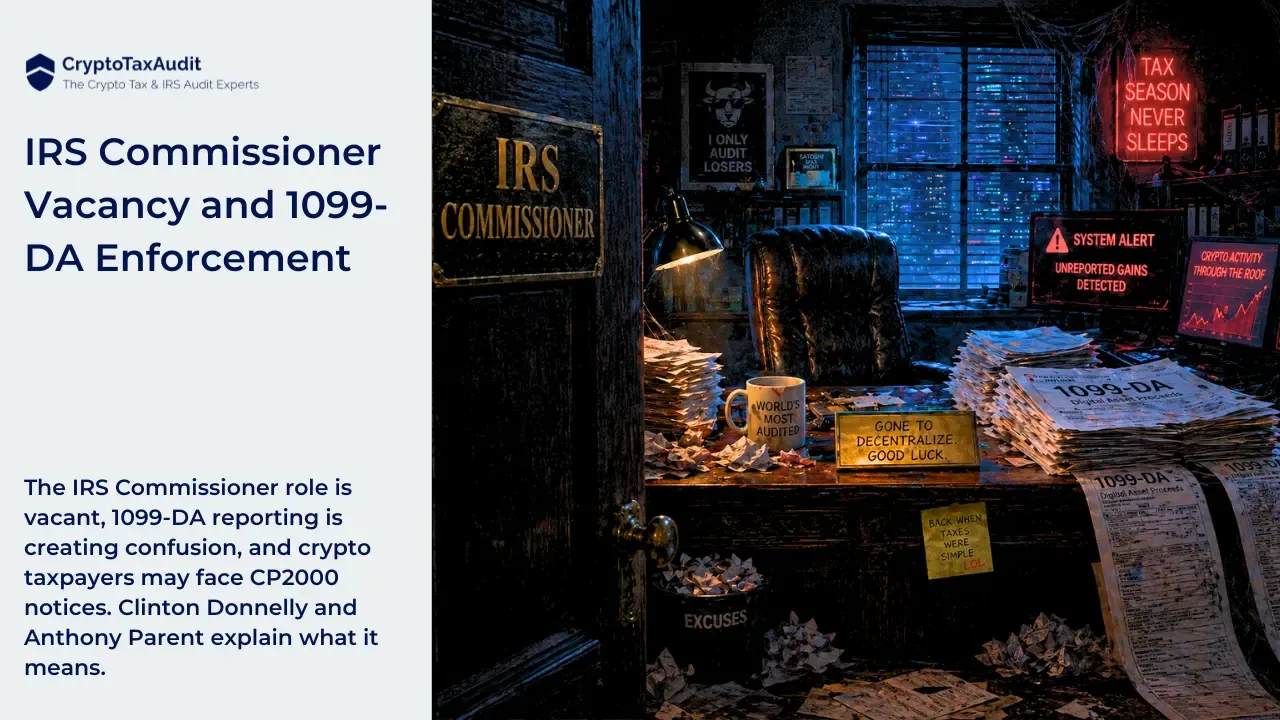
The IRS Commissioner's office is currently listed as vacant. The agency has not stopped operating. It is processing returns, sending notices, and handling enforcement under temporary and newly created leadership roles. But there is no Senate-confirmed Commissioner of Internal Revenue at the top.
At the same time, the first large wave of 1099-DA reporting is expected to affect crypto holders in 2026. Many of those forms are 20 to 30 pages long. They report proceeds without usable cost basis for transferred-in assets. Tax preparers are turning crypto clients away.
The conversation below, between Clinton Donnelly of CryptoTaxAudit and Anthony Parent of IRSMedic, walks through both stories. The IRS is moving toward more data-driven crypto enforcement at the same moment its authority chain is being challenged in court. Crypto taxpayers should pay attention to both.
Key Takeaways:
There is no Senate-confirmed IRS Commissioner. The IRS Commissioner's office is currently listed as vacant, while the agency continues operating under temporary and newly created leadership roles.
The Federal Vacancies Reform Act is central to the dispute. The general acting-service limit is 210 days when no nominee has been submitted. Some transition vacancies have a separate 300-day rule.
A motion to vacate has been filed in U.S. Tax Court. Anthony Parent argues that Tax Court orders raise a serious authority problem when the Commissioner's office is vacant. That argument has not yet been accepted in a published ruling.
Form 1099-DA reports proceeds, not necessarily taxable gain. A large proceeds number does not tell you whether the taxpayer had a gain, loss, or break-even result.
Transferred-in crypto creates basis and holding-period problems. Brokers often do not know the original acquisition date or cost basis when assets move in from outside wallets.
CP2000 notices may follow 1099-DA mismatches. CryptoTaxAudit expects the highest risk for taxpayers who receive a 1099-DA but do not account for the crypto activity at all.
The IRS Commissioner's Office Is Vacant
The IRS Commissioner is a Senate-confirmed presidential appointment. According to the IRS organization page, the Commissioner role is currently listed as vacant. Over the past year, the agency cycled through multiple acting officials. Billy Long was the only Senate-confirmed Commissioner during that period, and he left office shortly after his confirmation.
Treasury Secretary Scott Bessent stepped in as acting commissioner. Treasury then announced Frank Bisignano as the new Chief Executive Officer of the IRS, a newly created position for day-to-day operations. The CEO role is not the same thing as the Senate-confirmed Commissioner of Internal Revenue.
The IRS is still functioning. Returns are being processed. Notices are still going out. The legal question is narrower: whether enforcement actions tied to statutory Commissioner authority can be challenged when the Commissioner's office is vacant.
The Federal Vacancies Reform Act And The 210-Day Limit
The Government Accountability Office explains that the Federal Vacancies Reform Act generally limits acting service to 220 days when no nominee has been submitted. There are separate transition rules that can extend acting service in certain cases, but the core issue here is simple: temporary leadership is supposed to be temporary.
Senators Ron Wyden, Chuck Schumer, and Elizabeth Warren argued in March 2026 that Scott Bessent's acting authority appeared to expire on March 6, 2026, absent a pending nominee. No nominee had been submitted at that time.
That does not mean the IRS stops functioning. It means enforcement actions tied to statutory authority may face new legal challenges.
Why Tax Court Is The Pressure Point
Tax Court is an Article I court, not an Article III court. In Tax Court proceedings, the taxpayer is the petitioner and the Commissioner of Internal Revenue is the respondent. Tax Court has jurisdiction over a specific set of disputes, including notices of deficiency and final notices of intent to levy.
That matters here because Anthony Parent's argument depends on the identity of the respondent. If the Commissioner's office is vacant, and if acting authority has expired, he argues there may be a defect in the chain of authority behind certain Tax Court proceedings.
This is not settled law. It is a live legal theory. But it is serious enough that crypto taxpayers with IRS enforcement exposure should pay attention.
The Motion To Vacate: Anthony Parent's Argument
Anthony Parent has filed a motion to vacate in U.S. Tax Court. His argument is that a Tax Court order authorizing IRS collection cannot properly stand when the Commissioner's office is vacant and acting authority has expired.
The underlying case involved a Tax Court order that overturned a bankruptcy court's discharge of a tax debt. The IRS resurrected the discharged debt and issued a final notice of intent to levy. The taxpayer initially filed pro se. Anthony took the case after the taxpayer reached out for representation, argued the matter on summary judgment citing SEC v. Jarkesy, and lost.
The motion to vacate now argues that the resulting Tax Court order is directed at a Commissioner who does not currently exist as a confirmed officeholder. IRS counsel had not responded to the motion at the time of this conversation.
This argument has not yet been accepted by a court in a published decision. The legal theory is being debated on X, with both supporters and critics.
Crypto taxpayers with active IRS exposure should track how this plays out.
The Acting Chief Counsel Term And The Office Of Appeals Question
Kenneth Kies is currently listed as Acting Chief Counsel. According to Anthony, his term has approximately 46 days remaining. Anthony argues that once that term expires, the absence of a confirmed Commissioner creates a serious appointment problem for Chief Counsel.
David Borden is currently listed as Chief of the Independent Office of Appeals. Anthony argues that if Borden's appointment came through the new CEO structure, rather than a properly authorized Commissioner chain, it raises a separate authority question.
In Anthony's view, Tax Court, Office of Appeals, and Chief Counsel all rely on a chain of delegation orders that traces back to a Commissioner. He argues that when the Commissioner's office is vacant, every link in that chain becomes open to challenge. None of these arguments have been accepted in a published court decision yet.
Form 1099-DA Is Not A Clean Tax Number
Form 1099-DA is the IRS information return for digital asset proceeds from broker transactions. The first large wave of 1099-DA reporting is expected to affect crypto holders in 2026. The form reports proceeds, and in some cases basis, from digital asset dispositions.
The problem is that many first-year 1099-DAs do not give taxpayers a clean gain or loss number. For transferred-in assets, the broker often does not know the original purchase date or cost basis. That makes the form useful to the IRS for visibility, but confusing for taxpayers trying to determine what they actually owe.
A 1099-NEC tells a contractor exactly what to put on their return. A 1099-INT tells a depositor the taxable interest amount. The 1099-DA does not work that way for many crypto holders. The "1099" label creates an expectation the form does not meet.
Many 1099-DAs run 20 to 30 pages. The word "total" appears in multiple places on the form. Coinbase's filings have been particularly difficult to interpret. Tax preparers who measure returns in minutes often cannot decode the form within their normal time budget. As a result, accountants are turning crypto clients away this year.
Why Proceeds Numbers Can Be Misleading
The 1099-DA reports gross proceeds. For first-year reporting and transferred-in or noncovered assets, the broker often will not know the taxpayer's original cost basis or holding period. A $50,000 proceeds figure could correspond to a $200,000 loss, a $40,000 gain, or no taxable event, depending on basis the form does not show.
That gap is the central enforcement risk. If the IRS treats the proceeds figure as taxable income for matching purposes, the taxpayer can receive an automated notice that overstates their actual liability. An investor with millions in proceeds and $900,000 in costs has a real gain in the hundreds of thousands, not the millions.
Anthony's argument is that a proceeds-only 1099-DA should not be enough to calculate a tax liability by itself because it does not show basis. Whether the IRS still uses the mismatch to generate notices is a separate practical question.
CP2000 Letters: Who Is Most At Risk
A CP2000 is an automated underreporter notice. The IRS compares what taxpayers report against information reported by third parties. When there is a mismatch, the system generates a letter.
CryptoTaxAudit expects CP2000 notices to follow 1099-DA mismatches because the IRS already uses third-party information returns for automated underreporter matching.
The matching system looks at metadata: did the return account for the 1099-DA from the issuing exchange? Returns that appear to account for the exchange activity may be less likely to trigger the clearest mismatch, even if the numbers do not match precisely.
The taxpayers most at risk are those who received a 1099-DA and did not report any crypto activity on their return at all. That is the clearest mismatch and the most likely trigger for an automated letter.
CryptoTaxAudit's gain calculation service reconciles 1099-DA proceeds against actual cost basis across all wallets and exchanges.
The Transferred-In Wallet Problem
When an asset is transferred into an exchange from an external wallet, the exchange does not have the original cost basis or holding period. Under IRC § 6045A, broker reporting follows specific rules for what information must be provided.
For transferred-in assets, the broker often must use the transfer-in date as the acquisition date for reporting purposes. This causes long-term holdings to appear as short-term on the 1099-DA.
A typical scenario: an investor buys an asset, transfers it to a private wallet, then moves it back to the exchange a month before sale. On the 1099-DA, that asset shows up under short-term gains with a one-month holding period. The proceeds are totaled under short-term, even though the actual holding period was years.
Taxpayers may need to report the true acquisition date, basis, and holding period using their own records, especially where broker-reported information reflects a transfer-in date rather than the original purchase date.
IRS guidance, including Notice 2025-7 and related transition relief, has addressed when taxpayers may rely on their own books and records for digital asset identification. The practical takeaway is that complete personal records of every wallet transfer, original purchase, and cost basis figure matter more than ever.
Can The 1099-DA Regulations Be Challenged In Court?
The 1099-DA regulations span hundreds of pages. The original framework for crypto taxation in the United States traces back to IRS Notice 2014-21, which announced that general tax principles apply to virtual currency. Subsequent guidance and the 1099-DA regulations built on that foundation.
The DeFi broker reporting rule was challenged by industry groups and later nullified by Congress under the Congressional Review Act. President Trump signed legislation on April 10, 2025 (Public Law 119-5) nullifying the DeFi broker reporting obligations. That does not eliminate Form 1099-DA for custodial brokers. It means the DeFi broker rule is no longer the clean example for a live court challenge.
Other challenges to digital asset reporting rules remain possible under Loper Bright (which ended Chevron deference) and West Virginia v. EPA (the major questions doctrine). Court timelines are slow. Custodial-broker 1099-DA reporting is likely to remain in effect through at least the 2026 filing season.
AI In Tax Practice: TaxGPT, Wrong Answers, And The Counter-Spell
AI tools are now standard in tax practice and are also producing wrong answers at scale. Anthony argues that tools like TaxGPT consistently default to the IRS-favorable interpretation of any tax question.
He describes the pattern: a client emails an AI-generated tax question, the advisor pastes it into TaxGPT, the tool offers to draft a client response email, the advisor sends it. The client receives advice that is fast, polished, and frequently incorrect.
In response, Anthony built an internal AI tool called the IRSMedic Reality Check. The tool replicates how he thinks about cases. It was his own AI that surfaced the no-Commissioner issue as a viable legal argument.
The same AI capability is now available to taxpayers. Pro se filers are using AI to draft Tax Court petitions, motions, and responses to IRS notices. Some of those filings include legitimate legal arguments that previously required a tax attorney to surface. Anthony reports that Tax Court has begun discussing limits on AI-generated filings, citing the volume of substantive challenges to IRS authority.
The practical takeaway for tax practitioners: AI used as a shortcut produces shortcut work, which is itself replaceable by AI. AI used as a check, with active pushback when it produces wrong answers, retains practitioner value. For taxpayers, AI-generated tax advice should be verified against primary sources before acting on it.
If you have received a 1099-DA, a CP2000 letter, or any IRS notice related to crypto activity, the structural questions described in this article mean it pays to get a qualified review before responding. Book a consultation to review your specific situation.
Frequently Asked Questions About The IRS Commissioner Vacancy And 1099-DA Enforcement
Q: Is the IRS still operating without a confirmed Commissioner?
A: Yes. The IRS continues to process returns, issue refunds, and send notices. The Commissioner's office is currently vacant, but the agency is operating under temporary and newly created leadership roles. The legal question is whether certain enforcement actions tied to statutory Commissioner authority can be challenged on that basis.
Q: What is the Federal Vacancies Reform Act?
A: The Federal Vacancies Reform Act generally limits acting service in vacant Senate-confirmed positions to 210 days when no nominee has been submitted. Some transition vacancies have a separate 300-day rule. Senators Wyden, Schumer, and Warren argued in March 2026 that Scott Bessent's acting authority appeared to expire on March 6, 2026, absent a pending nominee.
Q: Why is Form 1099-DA different from other 1099s?
A: Other 1099 forms typically give the taxpayer a number that goes directly on the return. A 1099-NEC reports the contractor's income. A 1099-INT reports interest. The 1099-DA reports gross proceeds, and in some cases basis, but for many first-year filings and transferred-in assets, the broker does not know the original cost basis or holding period. The form alone may not be enough to calculate gain or loss.
Q: I received a 1099-DA and the proceeds figure is much higher than my actual gain. What do I do?
A: Report the actual gain on Form 8949 using your true cost basis and holding period. Keep complete records of every wallet transfer, original purchase, and cost basis figure. If broker-reported information reflects a transfer-in date rather than your original purchase date, you may need to report the correct acquisition date using your own records. If the IRS sends a CP2000, that documentation is what you will need to respond.
Q: I did not report my crypto activity but I received a 1099-DA. What is my exposure?
A: Taxpayers who received a 1099-DA and did not account for it on their return are at the highest risk for automated CP2000 letters. The IRS matching system flags returns that have no reference to the exchange that issued the 1099-DA. Filing a corrected return before the IRS contacts you generally results in lower penalties than waiting.
Q: Can the IRS legally send a CP2000 based only on a 1099-DA?
A: A CP2000 is an automated underreporter assessment. Anthony's argument is that a proceeds-only 1099-DA should not be enough on its own to calculate a tax liability because it does not show basis. Whether the IRS still uses the mismatch to generate notices is a separate practical question. The likely answer is that letters will go out anyway. Responding with proper Form 8949 documentation is the correct procedure.
Q: What happens to my open Tax Court case if there is no Commissioner?
A: Open Tax Court cases continue to be processed. The argument that the Commissioner vacancy creates a defect in Tax Court authority is currently being raised in a single test case via motion to vacate. That argument has not been accepted in a published decision. Practitioners with pending Tax Court matters should track the outcome before deciding whether to raise it in their own cases.
Q: Are the 1099-DA regulations going to be struck down?
A: The DeFi broker reporting rule was nullified by Congress under the Congressional Review Act in April 2025. Custodial-broker 1099-DA reporting was not affected by that action. Other challenges may follow under Loper Bright and West Virginia v. EPA. Custodial-broker 1099-DA reporting is likely to remain in effect through at least the 2026 filing season.
Q: My accountant will not take my crypto return this year. What are my options?
A: Many general tax preparers are declining crypto returns because the 1099-DA forms are too complex to interpret in a standard return-preparation timeframe. Working with a firm that specializes in cryptocurrency taxation is the most practical option. CryptoTaxAudit handles 1099-DA reconciliation, gain calculation, and IRS audit defense for crypto holders specifically.
Q: Need help responding to a 1099-DA, CP2000, or IRS notice related to crypto?
A: Book a consultation with CryptoTaxAudit to review your situation. We handle 1099-DA reconciliation, CP2000 responses, and Tax Court representation for cryptocurrency cases. TaxShield membership provides ongoing audit monitoring and defense for crypto investors throughout the year. Book a consultation.
About CryptoTaxAudit: We're a tax firm specializing in cryptocurrency tax preparation and IRS representation. Clinton Donnelly (LLM, EA) founded the firm in 2015 to handle the specific complexities of digital asset taxation that general accountants miss. We've been preparing crypto tax returns since before the IRS had clear guidance, and we were ready for the 1099-DA before the first forms hit taxpayers' mailboxes in 2026.
About IRSMedic: Anthony Parent of IRSMedic is the founder of a tax controversy firm handling complex IRS cases including offshore disclosures, streamlined disclosures, and cleanup work for taxpayers facing serious tax problems.
Watch the Full Conversation With Anthony Parent
Related Articles: Form 1099-DA Explained: What Crypto Investors Need to Know for 2026
Author