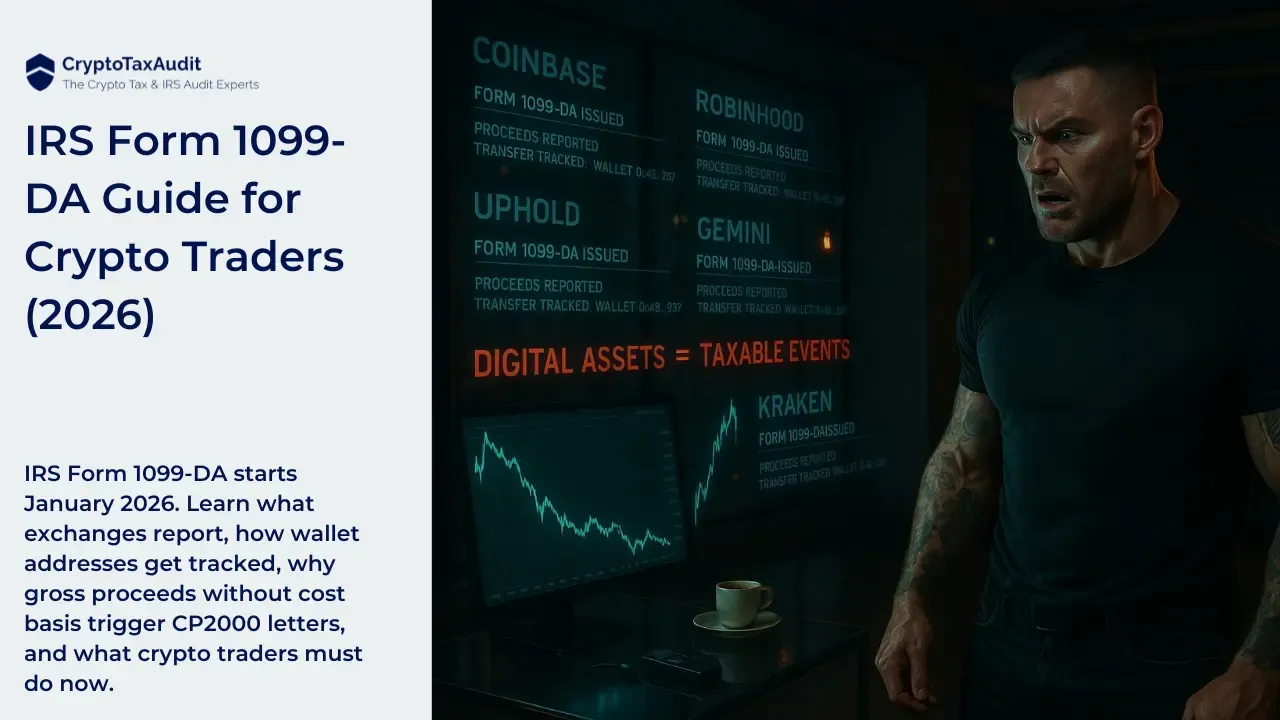
IRS Form 1099-DA: Complete Guide for Crypto Traders
By Clinton Donnelly, CEO, Founder | CryptoTaxAudit. Updated 05/04/2026
Key Takeaways
- Form 1099-DA is the IRS form used to report digital asset transactions.
- Year one reporting is expected to include gross proceeds, without cost basis.
- Wallet transfers and exchange activity can still show up in reporting records.
- Mismatch issues can lead to IRS notices, including CP2000 letters.
What is Form 1099-DA?
Form 1099-DA is a new IRS tax form for reporting digital asset transactions.
Starting in January 2026, centralized exchanges will be required to issue this form to report crypto sales and dispositions, dates acquired and sold, cost basis and proceeds, and gain or loss for each transaction.
It's the IRS's standardized form for reporting crypto activity, similar to how Form 1099-B works for stocks and bonds, but tailored specifically for digital assets.
When does Form 1099-DA reporting begin and what will be included?
The first 1099-DA forms are expected to be issued in January 2026 for the 2025 tax year.
In the first year, exchanges are expected to report only gross proceeds from sales and transfers, with no cost basis included.
Starting in 2027 and beyond, exchanges are expected to include cost basis when it is available to them.
This means in year one, if you sold $250,000 worth of crypto but your cost basis was $240,000, the IRS may only see the $250,000 proceeds figure without the corresponding basis context.
Why Does Your 1099-DA Show Millions?
A client called us recently in a panic. He traded only on Coinbase. Bought there, sold there, never left the platform. He figured he made around $80,000 in profit for the year.
Then his 1099-DA arrived showing $2 million in proceeds.
"This number can't be right," he said.
It was right. It just didn't mean what he thought it meant.
The proceeds number on your 1099-DA is a running total. Every time you sell or swap a coin, the sale amount gets added. It doesn't subtract what you paid. It just keeps stacking.
Say you start with $10,000. You buy a token, sell it, buy another, sell that, buy another.
Each of those sales adds to the total. Trade actively throughout the year and the number climbs fast.
That's how $10,000 in actual capital turns into $2 million in "proceeds" on a tax form.
Proceeds is not profit. It's the total value of your sales. The number that determines what you actually owe in taxes is something different entirely.
How Cost Basis Actually Gets Lost
This isn't a theoretical problem. Here's how it plays out in real life.
You put $10,000 into Coinbase and buy USDC stablecoin. You take $7,000 of that and buy Ethereum, $2,000 into Cardano, $1,000 into Doge.
Then you move everything to your private wallet.
Then you realize you need to send the Doge to a different exchange, because that's the only place you can swap Doge for whoop dee doo coin.
Now you're on a second exchange. You don't remember what you originally paid.
Meanwhile, you took half your Ethereum and sold it and turned it into more Doge.
That was $3,500. Now that Doge is mixed in with the $1,000 of Doge you already had.
Months go by. You're in and out of trades, moving coins around, splitting them and combining them. The trail disappears.
We've only met one person in our entire career who claimed they could track their own cost basis with a spreadsheet.
For everyone else, it's not realistic. Our team has had to take migraine medicine just trying to work through it.
Who will receive a Form 1099-DA?
People who sell or transfer digital assets on a U.S.-connected centralized exchange like Coinbase, Kraken, Gemini, Uphold, and Robinhood are expected to receive a 1099-DA.
The form is intended to report taxable events, including sales and certain transfers.
Purchases alone are generally not reported because they are not taxable, but transfers to or from other persons can be taxable.
How is Form 1099-DA different from 1099-K or 1099-B?
Form 1099-K is a general-purpose form for reporting third-party payments and does not include cost basis or gains, it reports gross receipts.
Form 1099-B is what traditional brokerage accounts typically use to show trades with acquisition date, sale date, cost basis, and gain/loss.
Form 1099-DA is the digital asset equivalent of 1099-B, tailored for digital assets.
It is expected to be included as part of a composite 1099 package that exchanges send, similar to how traditional brokerages send multiple forms.
Are private wallet transfers reported to the IRS?
Yes, when you transfer crypto from a centralized exchange to a private wallet, that transfer may be reported on the 1099-DA.
The IRS may receive the wallet address you sent to, the date of transfer, and the asset and amount as part of the reporting.
While transfers between your own wallets are not taxable events, they may still appear in reporting records.
The IRS may not initially know whether a wallet is yours, but as funds move across wallets, patterns can emerge that could be used to infer relationships between addresses.
Does the IRS collect wallet addresses under 1099-DA reporting?
Yes, wallet addresses are expected to be reported.
Centralized exchanges are expected to report outgoing transfers, including the wallet addresses where funds are sent.
The IRS has stated that wallet addresses are not personally identifying information and that the data is transferred securely.
However, over time, this can create a more detailed record of digital asset activity that could be traced across multiple wallets and platforms.
Is offshore crypto activity safe from IRS reporting?
No, offshore wallet activity can increase IRS scrutiny through inbound and outbound exchange reporting.
Every time you move crypto between an offshore wallet and a U.S. exchange, that activity is tracked.
Exchanges report both deposits and withdrawals, which allows the IRS to link offshore wallets to your identity and begin reconstructing your portfolio across platforms.
Do I need to report my 1099-DA even if I disagree with it?
Yes, even if you disagree with the numbers on your 1099-DA, you must still report it on your tax return.
If the form is missing from your return, the IRS will notice and may assume you underreported income, which can result in a CP2000 Notice billing you for what they think you owe.
You should report the form first and fix any discrepancies later with proper documentation.
What happens if my tax return doesn't match my 1099-DA?
The IRS will auto-flag any mismatch between what's reported on your 1099-DA and what appears on your tax return.
If there's a discrepancy, you can expect a CP2000 letter in your mailbox along with a proposed tax bill.
Because the first year only reports gross proceeds without cost basis, the IRS might see high-value sales with no basis data and assume your profit was 100%, billing you accordingly unless you have airtight records to prove otherwise.
Why should I care about Form 1099-DA right now?
The data that will show up on your 1099-DA is already being captured by exchanges.
If your records are sloppy, your cost basis is missing, or your internal transfers aren't tracked properly, the IRS might assume a gain where there wasn't one and trigger a hefty tax bill.
Once the 1099-DA becomes standard, the IRS will expect your return to match it exactly, and any mismatch will get you flagged.
Mistakes made now can become audit flags later.
What about mining and staking rewards will they be reported on Form 1099-DA?
Personal mining rewards you generate yourself aren't currently reported on a 1099-DA.
However, if you're using a hosted mining service or staking through a provider, that service might file a 1099-DA on your behalf.
The same applies to validators, especially those operating under U.S. entities or platforms.
Reporting obligations for miners, validators, and DeFi users are evolving rapidly.
Are DEX (decentralized exchange) trades included in 1099-DA reporting?
No, not directly.
DEXs aren't currently required to issue 1099-DAs.
However, the moment you bridge assets from a DEX back to a centralized exchange, that activity enters the IRS's reporting system.
That's when the IRS starts connecting the dots and will likely expect an explanation if the numbers don't add up on your tax return.
Why is FIFO-by-wallet now required for crypto?
The IRS now requires FIFO (First In, First Out) to be applied on a wallet-by-wallet basis for crypto transactions starting in 2025.
This replaces older methods like LIFO, HIFO, and universal pooling that many investors have legally used in the past.
This is a major shift and is catching many traders off guard.
The IRS is even attempting to apply this standard retroactively in some audit cases, reaching back to 2017 in documented instances.
The Exchange Emails That Saved an Audit
One of our clients was going through an audit. He had traded on an exchange that went defunct. It didn't exist anymore. There was no way to pull records from it.
But the IRS saw transfers coming into his Coinbase wallet from an outside address.
Coinbase was treating those incoming coins as income and taxing the full amount. The client knew it was his own money moving between platforms. He just couldn't prove it.
Here's what saved him. He still had the confirmation emails from that old exchange sitting in his inbox.
They were pretty weak, to be honest.
You'd want them to show how many coins, what type, maybe the cost price that day.
These emails basically said, "Hey, we completed your transfer."
But we matched the dates on those emails to the dates of the transfers into Coinbase.
We proved the outside address belonged to the defunct exchange. And that was enough to show the IRS that these were transfers of the client's own funds, not new income.
Without those emails, he would have been taxed on money that was already his.
Never delete your exchange emails. Even the ones that look useless. You don't know which records will matter until someone asks for them.
What steps should I take now to prepare for Form 1099-DA?
You should:
(1) Start tracking your cost basis for every transaction if you can't prove what you paid, the IRS may assume it was zero.
(2) Archive your exchange and wallet histories annually with CSV files, API exports, and screenshots before exchanges potentially go dark.
(3) Clean up and properly label internal transfers between your own wallets so the IRS doesn't count them as sales.
(4) Don't rely solely on the 1099-DA to tell your full story, especially if you trade across DEXs, self-custody wallets, or obscure platforms.
How is CryptoTaxAudit different from other crypto tax services?
Most crypto tax platforms just generate a report.
CryptoTaxAudit delivers audit-ready crypto gain calculations with advanced tools and expert oversight to match trades across wallets, exchanges, and blockchains accurately.
You get verified results, IRS-ready documentation, and fixed pricing based on trade volume. Unlike software-only services.
CryptoTaxAudit also defends you in an IRS audit, handling everything from calculating gains to preparing compliant returns to defending against IRS notices and enforcement tactics.
If You're a High-Volume Trader, You're Already on the IRS Radar
The 1099-DA reporting system targets one group harder than anyone else: traders with high Total Positive Income.
Total Positive Income (TPI) is the sum of all your wages and investment proceeds without subtracting costs or losses. If you're trading frequently or moving large amounts, you can hit $400,000 in TPI without being anywhere near that profitable.
The IRS has been focusing audit resources on individuals with TPI over $400,000 since 2024. And with 1099-DAs now feeding them detailed crypto transaction data, that focus is only getting sharper.
If you're in this category, waiting for a CP 2000 notice or audit letter isn't a strategy. It's a gamble.
CryptoTaxAudit's TaxShield membership is built specifically for high-volume crypto traders who need ongoing IRS monitoring and defense.
The service includes audit representation, IRS letter review and response, and debt resolution services.
It's not a one-time fix. It's continuous protection that starts with a risk review of your past filings and catches IRS problems before they turn into audits.
If you're already getting notices or you know your past returns have issues, TaxShield handles the response while you focus on trading instead of the tax code.
Can CryptoTaxAudit help if I'm behind on my crypto tax reporting?
Yes, CryptoTaxAudit specializes in helping crypto traders who are behind or have messy records.
The team handles forensic crypto accounting, fixes missing cost basis, reconciles exchange histories, and ensures your tax filings line up with what the IRS will see on your 1099-DA.
If the IRS sends you a letter or audit notice, CryptoTaxAudit doesn't just prep returns, they defend them with full representation.
Frequently Asked Questions About Form 1099-DA
Q: When will I receive my 1099-DA?
A: Exchanges must send 1099-DAs by January 31st for the prior tax year. If you used a US exchange in 2025, you should have your form by early February 2026.
Q: Why does my 1099-DA show millions in proceeds?
A: Your 1099-DA shows the total value of all your crypto sales and swaps during the year. It is a running total of proceeds, not your actual profit. If you traded frequently, that number can grow very quickly even if your real gain was much smaller.
Q: Does proceeds on Form 1099-DA mean profit?
A: No. Proceeds is the sale amount, not the profit. Your actual taxable gain is the difference between your sale proceeds and your cost basis, which is what you originally paid for the asset.
Q: Why is cost basis missing from my 1099-DA?
A: Cost basis is often missing when coins move between wallets or exchanges. Once assets leave a platform and come back later, the exchange may no longer know what you originally paid, so it reports the sale proceeds without the cost basis.
Q: What happens if I cannot prove my cost basis?
A: If you cannot prove your cost basis, the IRS can treat the full proceeds amount as taxable profit. That can lead to a much higher tax bill than you actually owe.
Q: What if my 1099-DA shows the wrong amount?
A: You still have to report it on your tax return. Include the 1099-DA proceeds, then subtract them out with proper documentation showing your actual cost basis and losses. The IRS matching system needs to see that you acknowledged the form.
Q: Can the IRS track my hardware wallet?
A: They can't see inside your hardware wallet. But if you transferred funds from a US exchange to that wallet, they have the wallet address from the 1099-DA. They can trace on-chain activity from that point forward using blockchain analytics.
Q: What happens if I used an offshore exchange?
A: Offshore exchanges don't issue 1099-DAs. But if you transferred crypto from a US exchange to an offshore platform, the US exchange reports that transfer. The IRS sees the outbound wallet address even if they don't know where the funds ended up.
Q: What's the penalty for not reporting a 1099-DA?
A: The IRS assesses tax on unreported 1099 income plus penalties and interest. For crypto, they assume 100% of the proceeds are profit if you don't report cost basis. A $50,000 sale becomes $50,000 of taxable income at your ordinary income rate.
Q: Should I keep old exchange emails and transaction records?
A: Yes. Keep all exchange emails, confirmations, and transaction exports. Even basic transfer emails can become important evidence if you ever need to prove where coins came from or defend your cost basis in an audit.
If you prefer video, here’s a full read-through on YouTube.
Related Articles: How the 1099-DA Tracks Private Wallets and Offshore Crypto Activity: What the IRS Will See!
Author