5 Crypto Tax Myths That Will Cost You in 2026
This year, something new showed up in crypto investors' mailboxes. Every U.S. crypto exchange now reports customer sales directly to the IRS on a form called the 1099-DA.
A whole new set of myths showed up with it. Some come from friends. Some come from Reddit. Some come from headlines that got the story half right.
Each of the five below can cost real money: tax on profits that never happened, penalties that didn't need to happen, or interest that keeps running while you wait for a deal that may never come. Here is what the rules actually say as of October 2026.
Key Takeaways
- A 1099-DA reports what you sold, not what you made: Under the Form 1099-DA rules, brokers must report basis only for digital assets acquired after 2025. For older coins, the basis box can be blank.
- Staking rewards are income when they hit your account: The Tax Court confirmed this in Paschall v. Commissioner, T.C. Memo. 2026-46, a Cardano staking case.
- The crypto wash sale rule could reach back to September 14, 2026: As introduced, H.R. 10357 applies wash sale rules to crypto sales after that date. It passed the House Ways and Means Committee 38-5 on September 16, 2026, but is not law.
- A computer, not an auditor, checks your 1099-DA: The IRS lost about 31% of its revenue agents through mid-2025, but return mismatches trigger automated CP2000 notices.
- A crypto amnesty is proposed, not law: H.R. 10357 would create a voluntary disclosure program with penalties as low as 0%, launched within 12 months of enactment.
Myth 1: My 1099-DA Is Correct, So I'll Just File What It Says
That's wrong. For most crypto holders, the 1099-DA shows what you sold your crypto for, not what you paid for it. File it as-is and you can pay tax on money you never made.
Here is why. For 2025, brokers reported gross proceeds. Under the Form 1099-DA instructions, basis reporting is required only for covered securities, meaning digital assets acquired after 2025 and held in that broker's custody. Bitcoin bought in 2021 and moved to Coinbase is noncovered. Its basis box can be blank.
Say the form shows $48,000 in proceeds and you paid $40,000. Your real gain is $8,000. (These figures are illustrative.) But if the sale isn't on your Form 8949 with a documented basis, the IRS matching system sees $48,000 with nothing to offset it.
That is when a CP2000 notice arrives, proposing tax on the full proceeds as if your cost were zero. Now the tax bill is calculated on $48,000 instead of $8,000.
The fix is a documented record of what you paid, built from your own exchange histories and wallet records. The broker's form is the IRS's starting point. It is not your finished answer.
Myth 2: Staking Rewards Aren't Taxed Until I Sell
Think again. Staking rewards are taxable income the day you gain control of them, valued at their fair market value that day. Selling later is a second, separate tax event.
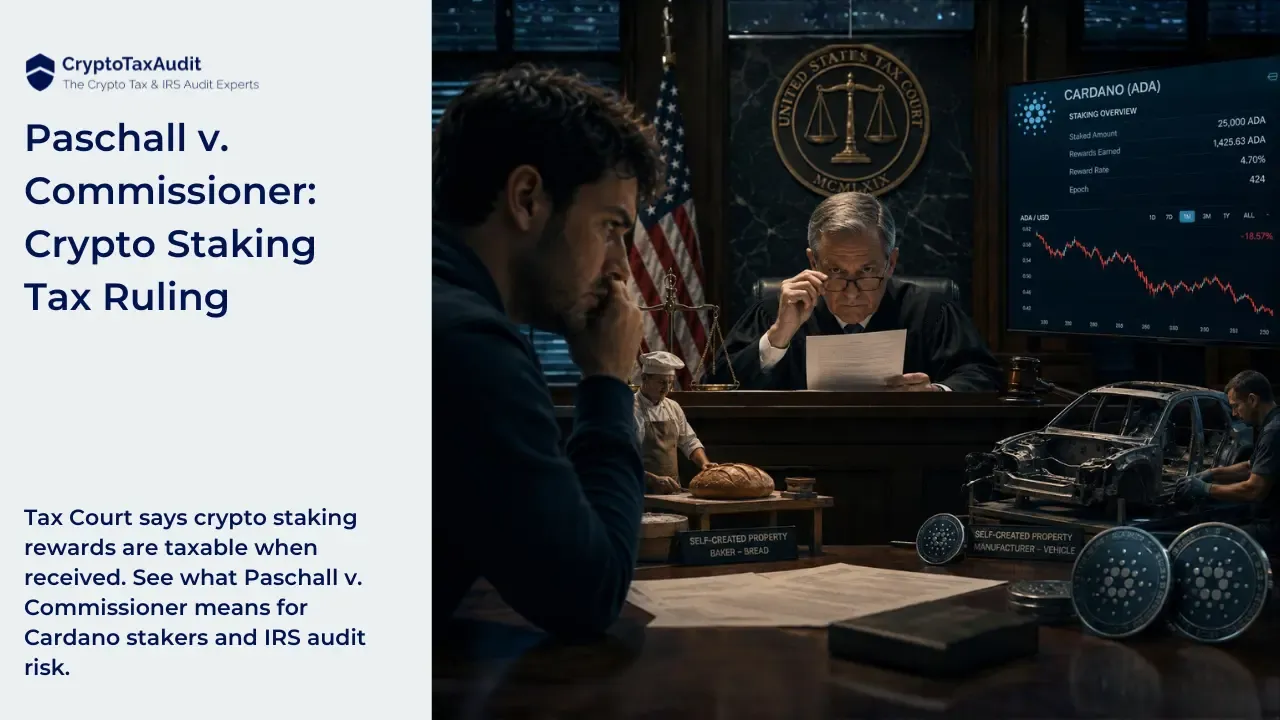
The IRS set out this position in Rev. Rul. 2023-14. In 2026, the U.S. Tax Court reached the same result in Paschall v. Commissioner, T.C. Memo. 2026-46.
The taxpayer staked Cardano through eToro, which staked customer tokens automatically unless they opted out. He argued the rewards weren't income until he sold, comparing them to stock dividends and self-created property. The court rejected both arguments and held the rewards were income in the year they were credited to his account.
The case has limits. The taxpayer represented himself, the facts were fully stipulated, and a memorandum opinion carries limited precedential weight. But it is now the leading court decision on staking income, and it lines up with the IRS position.
Congress isn't riding to the rescue either. An earlier draft of the House crypto tax bill would have let stakers defer tax until they sold. That option was dropped before the bill passed committee.
The bill labels staking and mining income as ordinary income, but it does not say when that income is taxed. It orders a Treasury study on withholding and reporting for staking, due by September 30, 2028.
Myth 3: I Can Harvest a Crypto Loss and Buy Right Back In
Under today's law, yes. But that window may already be closing, and it could close retroactively. As introduced, the House crypto tax bill would apply the wash sale rule to crypto sales made after September 14, 2026.
Right now, the wash sale rule in IRC Section 1091 covers only stocks and securities. A crypto investor can sell a coin at a loss, buy it right back, and still claim the loss. It has been one of the most valuable year-end tools crypto investors have.
H.R. 10357, the Digital Asset Tax Certainty Act would end that. Section 301 applies the wash sale rule to "traded digital assets," with stablecoins excluded. Wrapped or tokenized versions of the same asset count as substantially identical. A loss would be disallowed if the same or a substantially identical asset is bought within 30 days before or after the sale. Tokens received from staking or mining are excepted.
Here's the catch. The rule applies to "dispositions after the date of the introduction of this Act." The bill was introduced on September 14, 2026, and passed the House Ways and Means Committee 38-5 two days later. If it becomes law in this form, a loss harvested this fall with a quick rebuy could be disallowed after the fact. The same date applies to the bill's new constructive sale rules.
The bill is not law. It still has to pass the full House and the Senate and be signed. But while it is pending, CryptoTaxAudit's guidance is to talk to a crypto tax professional before harvesting losses this year. Waiting more than 30 days to buy back the same coin is the cautious path.
Myth 4: The IRS Lost Its Auditors, So Nobody's Checking
The IRS did lose a large share of its auditors. But a 1099-DA isn't checked by an auditor. It's checked by a computer, and CP2000 letters go out without a human examiner ever opening your file.
The cuts are real. The Treasury Inspector General for Tax Administration reported that IRS enforcement and collections staff fell from 27,217 at the end of fiscal 2024 to 17,517 by January 2026. More than 3,600 revenue agents left through mid-2025, about 31% of the agency's auditing corps.
None of that touches automated matching. Brokers file 1099-DAs. The IRS compares them to returns. When the numbers don't line up, the system proposes the tax. With 1099-DA reporting now live, that matching covers crypto for the first time at scale.
Criminal enforcement hasn't stopped either. In December 2024, Frank Ahlgren was sentenced to 24 months in prison for filing a false 2017 return that understated his bitcoin gains. Investigators traced his coins through wallet clustering and matched them to cash deposits in his bank accounts.
Myth 5: A Crypto Amnesty Is Coming, So I'll Wait
Maybe it is coming, and on paper it looks generous. But it isn't law, and waiting has costs that are already certain.
Section 502 of H.R. 10357 would order the IRS to set up a digital asset voluntary disclosure program within 12 months of enactment. Participants would file amended returns, pay the tax and interest, and pay a one-time penalty instead of the usual accuracy and fraud penalties.
Certified track:
You swear under penalty of perjury that nothing was willful or fraudulent. The look-back covers up to 3 years. The penalty is 0% on the first $25,000 of tax per year and 5% above that, if amended returns are filed within 12 months of the program's launch. After that, it rises to 5% on the first $100,000 and 10% above.
Uncertified track:
No such statement is required. The look-back covers up to 6 years, with protection from criminal referral for what is properly disclosed. The penalty is 25% on the first $25,000 and 40% above within the first 12 months, rising to 40% and 50% after that.
For a non-willful investor who simply didn't know how to report crypto, 0% on the first $25,000 a year is far better than anything the IRS offers today. There is a trade-off: taxes disclosed in the program can be assessed even if the normal statute of limitations has already run.
None of it exists yet. The bill has to pass the House, pass the Senate, and be signed. Then the IRS gets up to 12 months to launch the program. Meanwhile, interest on unpaid tax keeps running, every year of 1099-DA data gives the IRS more to match against, and under IRC Section 6501(c) there is no statute of limitations on a return you never filed or a return filed fraudulently.
Waiting is a bet on Congress. Even today, there are ways to get compliant, and the best path depends on your facts. If the program does launch, the choice between certified and uncertified matters a great deal. Don't make it alone.
What Should You Do If You Haven't Been Reporting Your Crypto?
Get a plan to become compliant before the IRS contacts you. Every myth above gets more expensive the longer it goes unaddressed.
First:
Gather every 1099-DA, plus exchange exports and wallet histories, including platforms that don't issue forms.
Second:
Rebuild your cost basis with documented records. A crypto gain calculation does this, including for coins whose basis box is blank.
Third:
Add staking rewards as income in the year you received them.
Fourth:
File or correct your returns through crypto tax preparation, with every sale on Form 8949.
After filing, Tax Shield membership keeps a team in your corner if an IRS letter arrives.
Frequently Asked Questions About Crypto Tax Myths in 2026
Q: My 1099-DA shows no cost basis. Do I owe tax on the whole amount?
A: No. You owe tax on your actual gain, but you have to document your basis. Brokers aren't required to report basis for digital assets acquired before 2026 or transferred in from another platform. Report the sale on Form 8949 with your own documented basis, or a CP2000 notice can propose tax as if your cost were zero.
Q: Are staking rewards taxed when I receive them or when I sell?
A: Both. Rewards are income at fair market value when you receive them, under Rev. Rul. 2023-14 and the 2026 Tax Court decision in Paschall v. Commissioner. When you sell them later, you report a capital gain or loss measured from that value.
Q: Can I sell crypto at a loss and buy it right back in 2026?
A: Under current law, the wash sale rule does not apply to crypto, so the loss is recognized. But as introduced, H.R. 10357 would apply the rule to crypto sales after September 14, 2026. If the bill passes in that form, a quick rebuy this fall could cost you the loss. Waiting more than 30 days to rebuy is the cautious path while it is pending.
Q: The IRS cut thousands of jobs. Is my crypto less likely to be checked?
A: Not for 1099-DA mismatches. Those are caught by automated matching and generate CP2000 notices without an auditor. Fewer revenue agents may mean fewer full audits, but the matching program runs either way.
Q: Should I wait for the crypto amnesty or fix my returns now?
A: The program only exists in a bill that hasn't passed. As written, it would offer penalties as low as 0% for certified non-willful filers, but the IRS would have up to 12 months after enactment to launch it, and interest runs in the meantime. Even today there are ways to get compliant, and the best path depends on your facts.
Q: I got a CP2000 notice about my crypto. What do I do first?
A: Don't ignore it and don't simply pay it. Check whether the proposed tax is based on proceeds with zero basis, gather your purchase records, and respond by the deadline on the notice with documented basis. A crypto tax professional can prepare the response.
Q: Need help with your 1099-DA or unreported crypto?
A: CryptoTaxAudit rebuilds cost basis, reconciles 1099-DAs, and defends crypto holders in IRS audits. Book a consultation to review where you stand.
Author