Kwong Penalty & Interest Abatement: What COVID-19 Tax Deadlines Mean for Your IRS Account
By Kent Bowen, EA, Director of Client Solutions | CryptoTaxAudit
A federal court has ruled that IRS filing and payment deadlines were legally paused for the entire COVID-19 pandemic period. If penalties or interest were assessed against you during that time, you may be entitled to a refund. But there is a deadline to act.
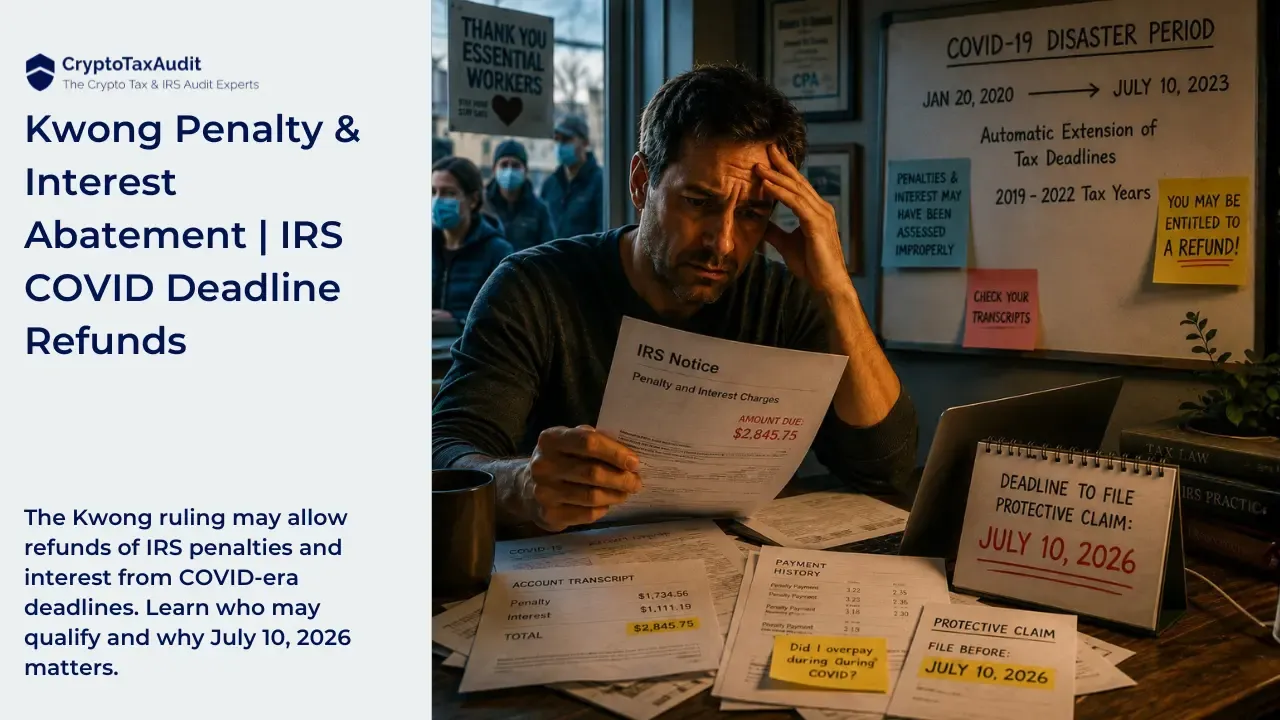
The case is called Kwong v. United States. It was decided by the United States Court of Federal Claims. The court found that a continuous, automatic extension applied from January 20, 2020 through July 10, 2023. That covers tax filings for 2019 through 2022.
The IRS is expected to challenge the ruling. That is why filing a protective claim before July 10, 2026, is critical. A protective claim preserves your right to a refund while the legal process plays out. If you miss the deadline, any future claim will likely be invalid.
Key Takeaways
A federal court ruled that COVID-19 automatically extended all federal tax deadlines from January 20, 2020 through July 10, 2023. The ruling covers tax filings for 2019 through 2022, which all fell within the federally declared disaster period.
Because deadlines were legally paused, the IRS may have had no legal right to assess late-filing or late-payment penalties or interest during that period. Taxpayers who were assessed or paid those charges may be eligible for a refund or abatement.
The deadline to file a protective claim is July 10, 2026. Failing to act before that date will likely bar any future refund claim, regardless of the court outcome.
Kwong is not a crypto-specific ruling. It applies to most taxpayers, regardless of income type, who were assessed IRS penalties or interest during the COVID disaster period.
The Kwong decision is not yet final. The government is expected to appeal. A protective claim preserves your refund rights while the case is still being litigated.
What Is Kwong v. United States?
Kwong v. United States is a recent United States Court of Federal Claims decision that may open the door to potential refunds of IRS penalties and interest assessed during the COVID-19 pandemic. This could be any amount, from $100 to $1 million dollars or more.
In this case, a federal court ruled that federal tax deadlines were automatically pushed back for the entire COVID-19 pandemic. For COVID-19, a federal disaster declaration was in effect from January 20, 2020, through May 11, 2023. Sixty additional days extended the period to July 10, 2023, for tax purposes. So tax filings for 2019 to 2022 fell within this period.
What This Potentially Means for Taxpayers
An automatic 3-year extension to file and pay was in place. Instead of the short extension the IRS previously offered, the court found that the law required a continuous, automatic pause on deadlines for over three years.
No penalties or interest should have been charged. Because the deadlines were legally "paused," the IRS may have had no legal right to charge late-filing or late-payment penalties or interest during that entire period.
A refund opportunity for many taxpayers. If you paid penalties or interest for any tax deadline that fell within those dates, you might be eligible for a refund or removal of penalties and interest assessed.
Remember, this is a trial-level court decision that the government is expected to appeal, so the final outcome is not yet certain. But there is a deadline to act. In most cases, the IRS does not issue refunds or abate tax assessed but not yet paid unless a taxpayer files a claim. To potentially get this money back, taxpayers need to file a claim by July 10, 2026, unless the IRS decides to issue these refunds without taxpayer action. Failing to act by the filing deadline would likely render any future claim invalid.
How to Check Whether You Qualify and File a Claim
Review your tax records and IRS account transcripts through your Individual Online Account on the IRS website.
Analyze your account activity during the 2020 to 2023 timeframe to verify whether any penalties or interest fees were charged. Remember this likely includes your 2019 to 2022 tax filings as they would have normally been due during this period.
How CryptoTaxAudit Can Help
Our firm provides IRS audit representation and resolution services for taxpayers at an affordable cost through a service called Tax Shield Full Defense. We actively monitor our clients' IRS accounts and will analyze their records to identify any penalty and interest payments that may qualify for abatement due to this ruling.
Our memberships include IRS Audit Representation and Resolution services. Taxpayers are covered for most issues that they could encounter with the IRS.
Get started with Tax Shield Full Defense
Taxpayers who want to utilize our expertise in IRS representation and resolution services for the Kwong-related penalty and interest waiver pay a one-time up-front cost of $979, plus our normal membership rate of $89 a month until the case is resolved and refunds are processed. All other membership benefits are also included.
Have questions? Schedule a consultation with one of our Enrolled Agents, who have extensive expertise in representing taxpayers before the IRS.
Act fast. You'll need to sign up soon so we can prepare the claims before by the July 10, 2026 deadline. New memberships must be purchased by May 31st to guarantee we can assist you.
Frequently Asked Questions About the Kwong Ruling
|
|
|
|
|
|
|
|
|
|
|
|
|
|
|
|
|
|
|
|
|
|
|
About CryptoTaxAudit: We're a CPA firm specializing in cryptocurrency tax preparation and IRS representation. Clinton Donnelly founded the firm to handle the specific complexities of digital asset taxation that general accountants miss. We've been preparing crypto tax returns since before the IRS had clear guidance, and we stay ahead of IRS enforcement developments like the Kwong ruling and its impact on taxpayers with assessed COVID-era penalties.
Author