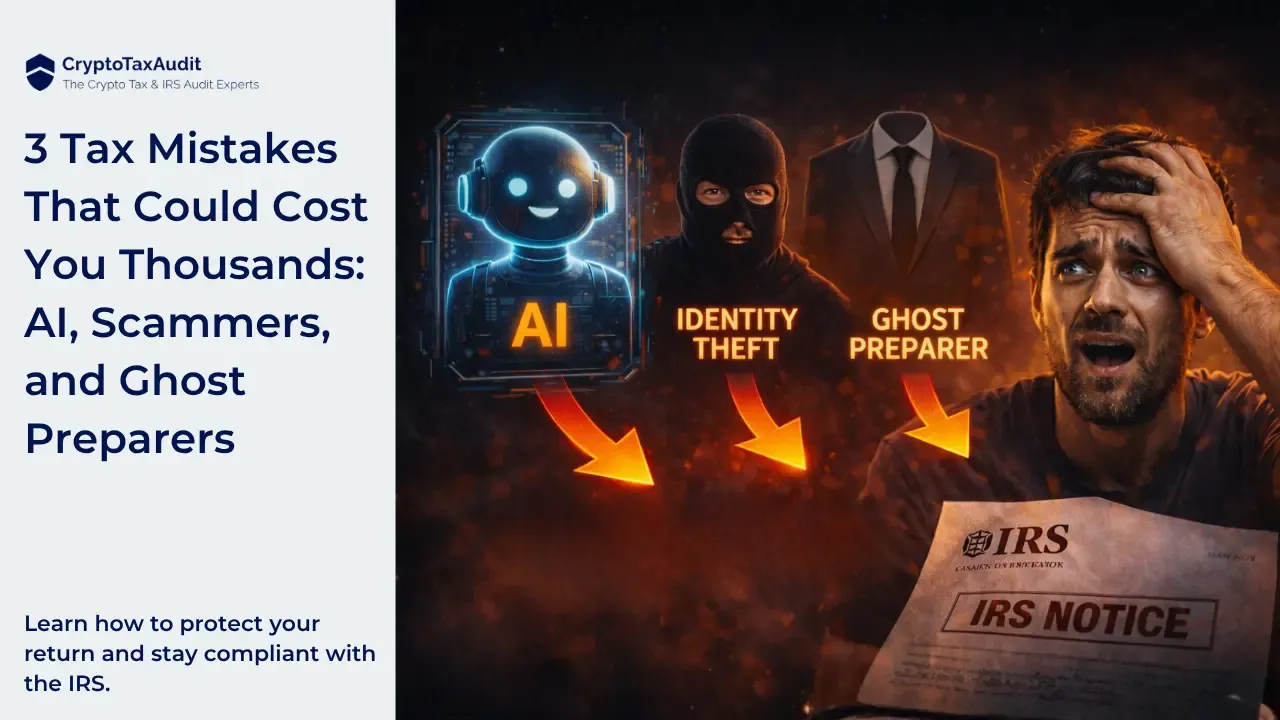
3 Tax Mistakes That Could Cost You Thousands: AI, Scammers, and Ghost Preparers
By Clinton Donnelly, CEO, Founder | CryptoTaxAudit
AI is amazing technology. But let’s not forget the first word: artificial.
Tax rules keep getting more complicated.
So more taxpayers are turning to AI tools, untrackable tax preparers, or unsecure methods to file their returns. It's costing them thousands of dollars.
Here is a breakdown of the three most dangerous tax mistakes you can make this season, and exactly how to protect yourself.
Mistake #1: Using AI to Fact-Check Your Tax Return
Here’s a trend that keeps growing. People take their TurboTax return, or the return their accountant prepared, and feed it into ChatGPT, Grok, Open Claw or whatever AI tool is popular that week.
The AI spits back a list of “errors.”
Sounds helpful. It’s not.
Tax law is incredibly detailed. When AI hits something that detailed, it hallucinates.
It can make things up.
And unless you’re a tax professional, you have no way to tell where the real answers end and the hallucinations begin.
Your accountant simplifies things on purpose. That’s the job.
They take a complicated tax situation and explain it in terms you understand.
Judging that explanation by what a chatbot says is not a fair test.
AI doesn’t claim to be a tax expert. Your CPA does.
One of them went to school, passed exams, and carries a license.
The other is a prediction engine.
Will AI Defend You in an Audit?
Picture this. You’re sitting across from an IRS auditor.
Your defense? “I typed it into Claude and it said I didn’t owe it.”
The auditor doesn’t care what Claude says.
They care what the tax code says. And you’ll owe what the tax code says you owe.
You are personally responsible for the tax return you file.
Finding an AI tool that disagrees with your preparer does not mean your taxes are wrong.
It means you found a tool that disagrees.
Mistake #2: Treating Your Tax Return Like Casual Mail
There’s an even bigger problem with feeding your return into AI or emailing it around without thinking.
Your tax return is packed with personal data. Your name. Your Social Security number. Your address. Your income.
Scammers use exactly that information to file a return in your name before you do.
They claim your refund. Then you’re the one stuck cleaning up the mess.
This isn’t hypothetical.
I had a client transferring from another preparer to our firm.
The previous preparer carelessly emailed her return as an unencrypted PDF.
Someone intercepted it.
A fraudulent return was filed claiming a $90,000 refund. It took considerable time to get that corrected.
The IRS Identity Protection PIN: Is It Worth It?
When the IRS flags you for identity theft, they assign you a 6-digit Identity Protection PIN.
You must enter that PIN every time you file. No PIN, no accepted return.
The IRS rejects it.
With Social Security numbers, names, and addresses floating around the dark web, identity theft is a growing risk.
You can request an IP PIN from the IRS before a problem ever happens.
There’s a tradeoff.
The PIN adds real security. But you have to wait for a new one in the mail every year.
Lose it, and you can’t file until a replacement arrives.
Some people value the protection. Others find it inconvenient.
|
Protecting Yourself from Identity Theft and IRS Surprises Waiting for a PIN in the mail is one approach. Year-round monitoring is another. Tax Shield watches your IRS account for warning signs, fraudulent filings, and audit flags before they become serious problems. See how Tax Shield works → |
Mistake #3: Hiring a Ghost Preparer
What Is a Ghost Preparer?
A ghost preparer fills out your tax return but refuses to sign it.
They won’t include their PTIN (Preparer Tax Identification Number) on the form.
By law, every paid preparer must have a valid PTIN and sign the returns they file.
If yours doesn’t, that’s a red flag.
They’re avoiding the legal liability that comes with putting their name on the work.
I saw this firsthand while living in Panama.
Clients came to me with returns done by people the community considered respected and trustworthy.
But when I reviewed them, not one had a PTIN.
These preparers were not licensed by the IRS. They didn’t sign because they couldn’t.
I saw it again with another client.
They paid someone to prepare their return. That preparer refused to sign.
Turns out, the IRS had revoked their license as a punishment.
They were no longer authorized to prepare returns.
But they kept doing it as a ghost preparer.
Fake PTINs Are Real
Some go even further. I’ve seen fake preparers put fake PTIN numbers on returns.
One client had no idea their preparer was fraudulent.
They thought they were working with an honest professional.
When I reviewed that return, I was able to amend it and recover a $16,000 refund.
The original preparer had reported income incorrectly and missed deductions the client was entitled to.
A good professional is worth the fee. That $16,000 wasn’t hiding.
It was sitting right there. The fake preparer didn’t know how to find it, or didn’t care.
|
Think your past returns might have problems? A good professional is worth the fee. Our team reviews prior filings, finds missed deductions, and fixes errors before the IRS does. |
The IRS Holds You Responsible, Not Your Preparer
This is what most people don’t realize.
The IRS holds you personally responsible for the accuracy and completeness of your tax return.
Not your preparer. Not the software. You.
An unlicensed preparer has no skin in the game. If the return is wrong, they disappear. You’re the one who gets the letter.
For years, the IRS has pushed Congress to pass laws preventing unauthorized preparers from operating.
Those laws still haven’t passed.
Until they do, it’s on you to verify the person doing your taxes is licensed and willing to put their name on the return.
3 Rules for a Safer Tax Season
One: Don’t use AI to second-guess your tax professional. It can’t tell you what it doesn’t know.
Two: Don’t upload your tax return to any AI tool, and never send it unencrypted. Your personal data is too valuable to risk.
Three: Check your preparer’s PTIN. If they won’t sign the return, walk away.
Tax season is stressful enough. Don’t add these problems to the pile.
Key Takeaways
AI can’t defend you: A chatbot disagreeing with your CPA is not proof your taxes are wrong, and it won’t hold up in an audit.
Your return is a goldmine for thieves: Unencrypted tax returns lead to stolen refunds. One client lost $90,000 to an intercepted email.
Ghost preparers are everywhere: If your preparer won’t sign the return or provide a valid PTIN (Preparer Tax Identification Number), walk away.
Frequently Asked Questions About Tax Mistakes, AI, and Preparers
|
|
|
|
|
|
|
|
|
|
Ready to file with confidence? Whether you need crypto gain calculations, full tax preparation, or IRS monitoring, our licensed CPAs and Enrolled Agents can help. Talk to a crypto tax expert → |
Related Articles: Keeping Safe from AI-Powered Crypto Scams: A Practical Guide
This article is for informational purposes only and does not constitute legal or tax advice. Tax laws can change, and every situation is different. For guidance specific to your situation, consider speaking with a qualified tax professional or the team at CryptoTaxAudit.
Author