
What Is Form 1099-DA? IRS Crypto Reporting for Wallets and Trades (2026 Guide)
By Clinton Donnelly, CEO, Founder | CryptoTaxAudit
You pull a 1099-DA form from an email from Coinbase. You've never seen this form before.
It's new for 2026.
And it lists everything: every crypto sale you made in 2025, every time you transferred funds off the exchange, the wallet addresses where those funds landed.
Then it hits you: the IRS got this same form in January.
They know what you sold. They know where you moved it. And if you don't report this form on your tax return, they're going to assume you owe them money on every dollar listed.
Here's what Form 1099-DA actually reports and why it matters more than any crypto tax form you've dealt with before.
Key Takeaways
Form 1099-DA started in January 2026 and reports all 2025 crypto activity from US exchanges. Coinbase, Kraken, Gemini, Robinhood, and every other US-tied platform now sends these forms directly to the IRS. This creates a direct pipeline of your complete trading activity to federal tax authorities.
The first year reports only proceeds, not cost basis. The IRS sees gross sales numbers but has no context for profit or loss. They'll assume you owe tax on 100% of the proceeds unless you document your actual cost basis on your return.
Every wallet address you transferred funds to appears on your 1099-DA. The exchange reports outbound transfers with the receiving wallet address visible to the IRS. This lets them trace wallet-to-wallet movements and map your entire crypto portfolio across platforms over time.
Not reporting a 1099-DA triggers automated IRS matching and CP 2000 notices. The system flags missing 1099s when you file electronically. You'll get a bill for the full proceeds amount calculated as taxable income at your ordinary rate.
You must report your 1099-DA even when the cost basis is wrong or missing. Exchanges often lack an accurate cost basis for crypto transferred between platforms or from private wallets. You can't skip the transaction just because the numbers look wrong. Report it and document the correct basis yourself.
High-volume traders with Total Positive Income over $400,000 are priority IRS audit targets. TPI is the sum of all proceeds before subtracting costs or losses. Frequent trading can push you past this threshold even when you're not profitable, putting you in the IRS enforcement spotlight.
What Is Form 1099-DA?
The 1099-DA stands for Digital Assets.
It works like other 1099 forms, but it's built specifically for crypto.
Any centralized exchange with US ties has to generate these. Coinbase, Kraken, Gemini, Uphold, Robinhood, Fidelity, Franklin Templeton, Swan. If the exchange operates in the US, they're reporting.
The form shows every sale and transfer you made on that platform. Not purchases. Those aren't taxable events, so they're not included.
But if you sold crypto or moved it off the exchange? The IRS sees it.
Who Gets a 1099-DA?
Anyone who sold or transferred assets from a US centralized exchange gets one.
DEX users and DeFi traders won't receive these forms. Decentralized platforms currently don't have the same reporting obligations as centralized exchanges.
But if you touched Coinbase, Kraken, or any US exchange in 2025, expect a 1099-DA in your mailbox this tax season.
What Shows Up on the 1099-DA?
The first year of 1099-DAs (for the 2025 tax year) only reports proceeds. That's the total value of what you sold.
No cost basis. No purchase price. Just big numbers sent to the IRS.
The exchange needed time to modify its systems. So for 2025, the IRS sees your gross sales but has no clue if you made money or lost it. They just see dollar amounts.
Starting with the 2026 tax year, exchanges will report cost basis if they have it.
But here's the problem: they won't always have it.
If you bought crypto on one exchange and transferred it to another before selling, the selling exchange doesn't know what you paid. The cost basis field stays blank.
The IRS sees the sale. They don't see your loss.
Why Wallet Addresses Matter More Than You Think
Here's where it gets serious. The 1099-DA includes wallet addresses for every transfer off the exchange.
Let's say you buy $1,000 of Bitcoin on Coinbase. You transfer it to your Ledger hardware wallet. That wallet address goes straight to the IRS on the 1099-DA.
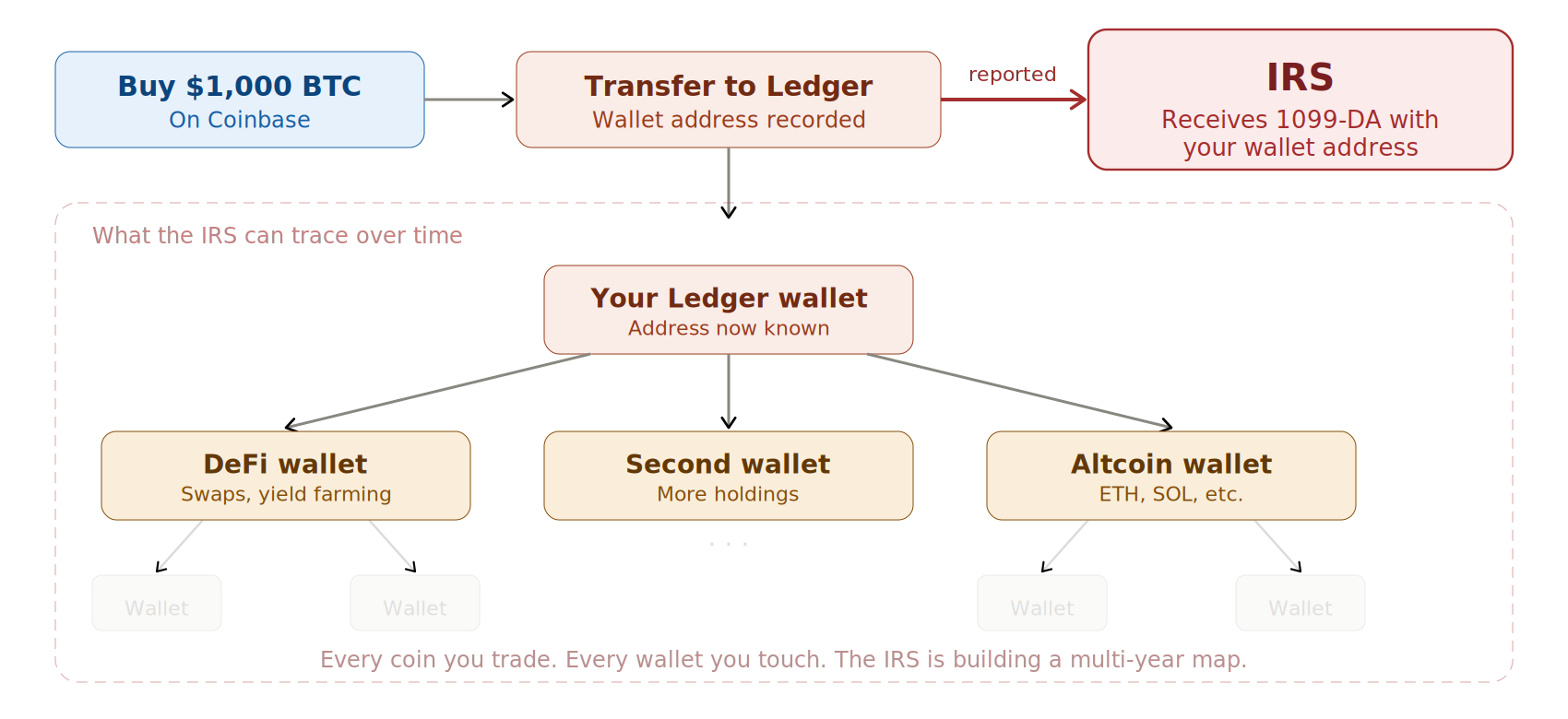
They won't know it's your personal Ledger. But they know the address exists. And they can trace it.
Over time, the IRS can map your entire crypto portfolio by tracking wallet-to-wallet movements. Every transfer from that initial address to other wallets starts to paint a picture of your holdings.
This isn't just Bitcoin. It's every coin you trade and every wallet you touch.
The IRS is building a multi-year view of your crypto activity. That's why this form matters more than any 1099 you've ever dealt with.
What Happens If You Don't Report Your 1099-DA?
Not reporting a 1099-DA on your tax return triggers an IRS matching system.
When you file electronically, the software flags every 1099 you include. The IRS cross-checks it against what they received from exchanges.
If something's missing, they notice.
You'll get a CP 2000 notice. That's the IRS saying, "You didn't report this income. We calculated what you owe. Here's your bill."
They assume 100% profit because they don't have your cost basis. A $50,000 sale becomes $50,000 of taxable income in their eyes, even if you lost money.
The CP 2000 is not an audit. It's worse. It's an automated income assessment. And it puts you on the IRS's short list for crypto under-reporters.
You have to report every 1099-DA on your return, even if the numbers are wrong. We cover how to handle incorrect 1099 reporting in our 1099-DA resource guide.
The Privacy Problem: Your Wallet Addresses Are Now Government Records
People have complained loudly about wallet address disclosure on the 1099-DA.
The IRS says wallet addresses aren't sensitive information. They claim the data gets transferred securely and stored privately.
Their position: trust us with your financial identity.
But here's what's actually happening. The IRS is collecting years of wallet addresses tied to your Social Security number. They can trace funds across wallets. They can build a complete picture of your crypto holdings without asking.
This is financial surveillance at scale. And it started this tax season.
How Crypto Moves Between Exchanges and Wallets Get Reported
Let's walk through a typical transaction cycle:
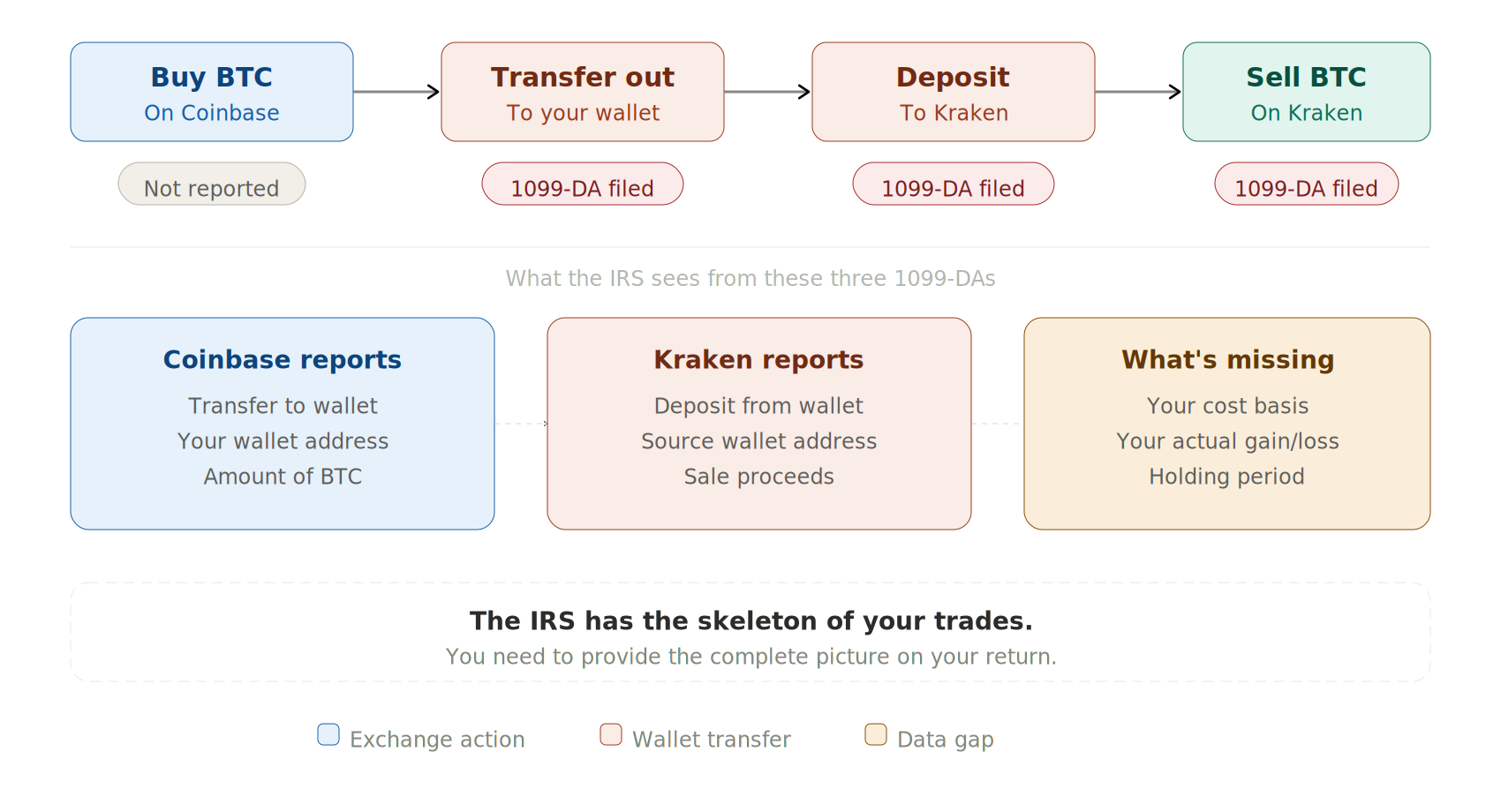
The IRS now has three data points: your original purchase exchange, your wallet address, and your sale on a different platform. They see the transaction trail. They just don't know your actual profit or loss.
This is why proper documentation matters more than ever.
The IRS has the skeleton of your trades. You need to provide the complete picture on your return.
What Mining and Staking Rewards Mean for 1099-DA Reporting
Mining done privately doesn't generate a 1099-DA. You're not using an exchange or third-party service, so there's no reporting obligation on their end.
But if you use a mining pool or cloud mining service, that service might issue you a 1099-DA for your mining income.
Validators face a gray area. If you're validating through your own node, you probably won't get a 1099-DA. If you're using a staking service that pools funds, they might have reporting obligations.
The regulations haven't fully caught up with PoS systems yet. Expect this to clarify over the next few years as the IRS sees how these transactions flow.
For now: if a third party controls or processes your staking rewards, assume they might report it.
The Simple Investor Strategy: Keep Everything on One Exchange
If you're not moving crypto off exchanges, the 1099-DA system actually works in your favor.
Let's say you do all your trading on Coinbase. You never transfer to a private wallet. You never use multiple exchanges.
Coinbase knows your complete cost basis. They report everything: what you bought it for, what you sold it for, your profit or loss.
Starting with the 2026 tax year reporting, this looks exactly like a stock brokerage 1099-B. You take the profit number from the form and put it on your tax return. Done.
Stock traders have worked this way for decades. The 1099-B reports everything accurately because the brokerage sees the whole trade lifecycle.
But most crypto investors don't work this way. They move funds between exchanges. They use hardware wallets. They hold assets across multiple platforms.
That's where the 1099-DA becomes a nightmare.
Cost basis gets fragmented. Exchanges report transfers without context. And you're left proving to the IRS that you didn't make the profits they think you did.
What You Should Do Right Now
First: expect a 1099-DA from every US exchange you used in 2025.
Second: don't ignore these forms. Every single one needs to show up on your tax return, even if the numbers look wrong.
Third: document your cost basis now. If you bought crypto on one exchange and sold it on another, you need records that connect those transactions.
Fourth: if you transferred crypto to private wallets or between exchanges in 2025, map those movements. The IRS has the wallet addresses. You need to explain what happened with those transfers.
The IRS isn't guessing anymore. They have transaction data flowing in from every major exchange. Your job is to make sure your tax return matches their records and tells the complete story of your actual profits and losses.
If You're a High-Volume Trader, You're Already on the IRS Radar
The 1099-DA reporting system targets one group harder than anyone else: traders with high Total Positive Income.
Total Positive Income (TPI) is the sum of all your wages and investment proceeds without subtracting costs or losses. If you're trading frequently or moving large amounts, you can hit $400,000 in TPI without being anywhere near that profitable.
The IRS has been focusing audit resources on individuals with TPI over $400,000 since 2024. And with 1099-DAs now feeding them detailed crypto transaction data, that focus is only getting sharper.
If you're in this category, waiting for a CP 2000 notice or audit letter isn't a strategy. It's a gamble.
CryptoTaxAudit's TaxShield membership is built specifically for high-volume crypto traders who need ongoing IRS monitoring and defense.
The service includes audit representation, IRS letter review and response, and debt resolution services.
It's not a one-time fix. It's continuous protection that starts with a risk review of your past filings and catches IRS problems before they turn into audits.
If you're already getting notices or you know your past returns have issues, TaxShield handles the response while you focus on trading instead of the tax code.
Frequently Asked Questions About Form 1099-DA
Q: When will I receive my 1099-DA?
A: Exchanges must send 1099-DAs by January 31st for the prior tax year. If you used a US exchange in 2025, you should have your form by early February 2026.
Q: What if my 1099-DA shows the wrong amount?
A: You still have to report it on your tax return. Include the 1099-DA proceeds, then subtract them out with proper documentation showing your actual cost basis and losses. The IRS matching system needs to see that you acknowledged the form.
Q: Do I need a 1099-DA for DeFi transactions?
A: No. Decentralized exchanges and DeFi protocols don't issue 1099-DAs. But you still owe taxes on DeFi gains. You're responsible for calculating and reporting that income yourself.
Q: What happens if I used an offshore exchange?
A: Offshore exchanges don't issue 1099-DAs. But if you transferred crypto from a US exchange to an offshore platform, the US exchange reports that transfer. The IRS sees the outbound wallet address even if they don't know where the funds ended up.
Q: Can the IRS track my hardware wallet?
A: They can't see inside your hardware wallet. But if you transferred funds from a US exchange to that wallet, they have the wallet address from the 1099-DA. They can trace on-chain activity from that point forward using blockchain analytics.
Q: What if my exchange doesn't know my cost basis?
A: You're responsible for providing it. If you bought crypto on Exchange A and sold it on Exchange B, Exchange B reports the sale with a blank cost basis field. You need to document your original purchase and report the correct gain or loss on your return.
Q: Should I keep all my crypto on one exchange to simplify 1099-DA reporting?
A: If tax simplicity is your priority, yes. Keeping everything on one platform means the exchange tracks your complete cost basis. But this trades off custody and control. It's a personal decision based on your priorities.
Q: What's the penalty for not reporting a 1099-DA?
A: The IRS assesses tax on unreported 1099 income plus penalties and interest. For crypto, they assume 100% of the proceeds are profit if you don't report cost basis. A $50,000 sale becomes $50,000 of taxable income at your ordinary income rate.
Q: Need help sorting through multiple 1099-DAs and proving your actual tax liability?
A: CryptoTaxAudit handles these exact situations. We prepare returns that satisfy IRS matching requirements while documenting your real gains and losses.
About CryptoTaxAudit: We're a CPA firm specializing in cryptocurrency tax preparation and IRS representation. Clinton Donnelly (CPA, EA) founded the firm to handle the specific complexities of digital asset taxation that general accountants miss. We've been preparing crypto tax returns since before the IRS had clear guidance, and we stay ahead of regulatory changes like the 1099-DA requirement.
Related Articles: IRS Form 1099-DA: Complete Guide for Crypto Traders
Author