
Why Is the Coinbase 1099-DA So Confusing?
Coinbase is criticizing the IRS tax reporting rules for crypto. They're calling them cluttered and confusing. But here's the problem. Coinbase built the report. They chose how to present it. And they did a terrible job.
What Did Coinbase Get Wrong on the 1099-DA?
Coinbase created subtotals of different types of assets. But they used the word "total" where it should have been "subtotal." There was never a bottom line total, the one number you actually need for your tax return. You don't know what to put on the return (assuming you are just reporting the totals which is far easier).
Here's what that actually looks like:
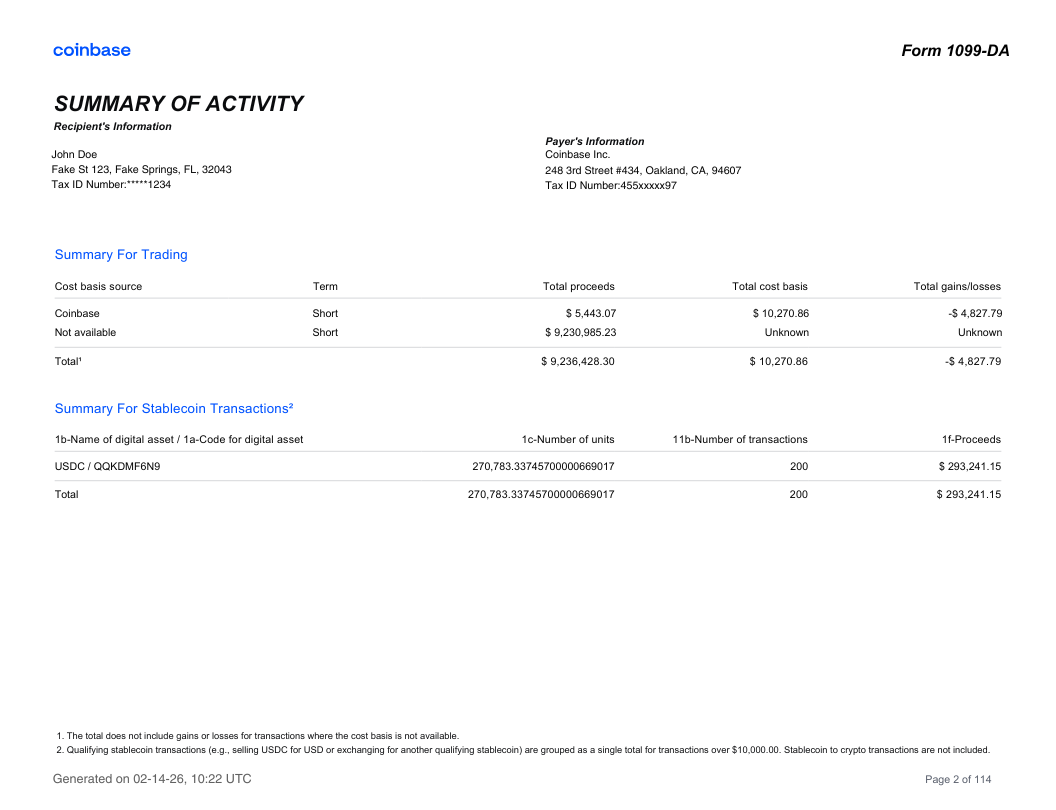
Look at the "Summary For Trading" table. The "Total" row shows -$4,827.79 in gains/losses. But that number only reflects the one line where Coinbase knew the cost basis. The $9.2 million in proceeds from the "Not available" row? Not included in that total at all. The footnote at the bottom of the page says so: the total does not include gains or losses where cost basis is not available.
That's a "Total" that isn't a total.
Then look below it. There's a separate "Summary For Stablecoin Transactions" showing $293,241.15 in proceeds from 200 USDC transactions. That's reported in its own table with its own "Total" row. No combined bottom line anywhere on the page.
So you've got two separate tables, two separate "Totals," and no single number you can put on your tax return.
The formatting was a mess too. Super small font. Data that wraps around the page. Their own IT teams didn't generate reports that were readable. It was an extremely sloppy job in terms of how they chose to deliver a 1099.
Coinbase's own staff did a terrible job of structuring their 1099 report. They did it in a way that was confusing to everybody. Messy and ugly.
Confused by Your Coinbase 1099-DA? Get Your Crypto Gains Calculated.
If your exchange reports don’t add up, you need accurate gain and loss calculations before you file. Our team reconciles your full transaction history across wallets and exchanges so the numbers on your return match what the IRS has on file.
How Do Stockbrokers Report the Same Information Clearly?
This isn't a new problem. A lot of people trade stocks in and out, in and out, all year long. All of that has to be reported to the IRS.
But here's what stockbrokers do.
They generate what they call a 1099 Consolidated form. It's their own document.
Any interest, any dividends, any capital gains activities are all listed separately.
First, they list the bottom line totals. Those are the numbers you can put directly into your tax return.
Then they provide the detail to support those totals.
It's very concise.
Here are the bottom line amounts for your tax return. Here's the details. Save these for your records.
That's all you need.
Coinbase should study what stockbrokers have done. They've had this figured out for years.
Is Coinbase Blaming the IRS for Its Own Mistakes?
In a February 2026 blog post, Coinbase said they believe "some aspects of the new reporting rules go too far." Their VP of Tax Lawrence Zlatkin told CoinDesk he thinks requiring reporting on small retail transactions "does a disservice to people."
They whine about having to report small transactions. Get up and get over it. They've been doing that in stocks for a long time.
Have you ever heard of penny stocks?
The IRS requires Form 1099-DA reporting for all digital asset sales starting with tax year 2025.
That came from Treasury Decision 10000, published July 2024. These rules were years in the making.
They trace back to the Infrastructure Investment and Jobs Act signed in 2021, which amended IRC Section 6045.
Coinbase was not limited by the government in what they could report. They hid behind what the government required and just put forth all that confusion.
They really did not take a user experience perspective on what they were doing.
If the rules were genuinely confusing, they should have been pushing back ahead of time.
They didn't complain about it while they were coding it. They're doing it now, after everybody came out and said the reports were confusing.
Coinbase is just whining because they're being embarrassed by the quality of their 1099-DA.
What Should You Do If Your Coinbase 1099-DA Doesn't Make Sense?
For tax year 2025, Coinbase only reports gross proceeds to the IRS. Not your cost basis. That means the IRS sees the full sale amount but not what you paid for the asset.
I was talking with a man just today who was very distressed about his Coinbase 1099-DA. All he traded on was Coinbase.
He bought on Coinbase, sold on Coinbase. Everything was on Coinbase. He felt he had made maybe $80,000 of profit that year.
But the 1099-DA from Coinbase showed $2 million in proceeds. He said, this number can't be right.
I said, wait. The proceeds number gets higher and higher the more you trade.
If you have $10,000 worth of coin and you buy $10,000 of that, then sell and buy another $10,000, then another $10,000, that's $30,000 in proceeds.
That's how you get to the $2 million number.
You need to focus on the difference between proceeds and cost basis.
That's your actual gain or loss.
The problem this year is that Coinbase isn't reporting cost basis to the IRS. And very few people trade exclusively on one exchange.
So the information on the 1099-DA is only a partial view of a taxpayer's picture. It puts forward large numbers, which can get the IRS excited.
The good news is the IRS knows that. This first year is a transition year. They're not really going to be too worked up over these large numbers on your tax return.
But it's imperative that your tax preparer enter the information from the 1099-DA.
You don't see it on the tax return, but it's kept in the metadata when it's electronically filed. The IRS will note that you accounted for that 1099-DA.
That's what they're going to look for.
You definitely want to account for it. You don't account for it, you're going to get an audit letter in about 12 months.
Key Takeaways
Coinbase used the word "total" where it should have said "subtotal," making it unclear what number belongs on your tax return.
Stockbrokers solved this problem years ago with consolidated 1099 forms that lead with bottom-line totals and provide supporting detail underneath.
Coinbase was not limited by the IRS in how it could present the data. They chose to deliver a confusing, poorly formatted report.
For 2025, Coinbase reports only gross proceeds to the IRS, not cost basis. You must calculate your own gains and losses.
A mismatch between your return and the IRS copy of your 1099-DA can trigger a notice or audit.
Clinton Donnelly is a CPA and Enrolled Agent who has defended hundreds of crypto investors in IRS audits. He is the founder of CryptoTaxAudit.
Don't Let a Confusing Report Turn Into an IRS Problem.
TaxShield monitors your IRS account so you'll know the moment something goes sideways. If a 1099-DA mismatch triggers a notice or audit, you'll have a crypto tax defense team already in your corner.
Related Articles: 1099-DA Crypto Taxes Explained: How to Fix Exchange Errors Using Form 8949
Author